Elasmobranquios (tiburones y rayas) (sharks and rays) >
Carcharhiniformes (Ground sharks) >
Carcharhinidae (Requiem sharks)
Etymology: Rhizoprionodon: rhiza (Gr.), root; prion (Gr.) saw; odon (Gr.), tooth, referring to teeth with serrated (saw-like) bases, or roots [replacement name for Rhizoprion Ogilby 1915, preoccupied by Rhizoprion Jourdan 1861 in mammals] (See ETYFish); porosus: Latin for pored or full of holes, referring to enlarged hyomandibular pores on both sides of head (See ETYFish).
More on author: Poey.
Entorno: milieu / zona climática / rango de profundidad / gama de distribución
Ecología
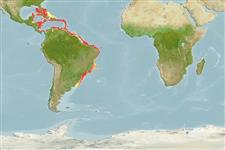
marino; agua dulce; salobre asociado a arrecife; rango de profundidad ? - 500 m (Ref. 244), usually ? - 100 m (Ref. 244). Tropical; 28°N - 40°S, 88°W - 32°W (Ref. 55194)
Western Atlantic: Caribbean, including the Bahamas, south to Uruguay. The separation of this species from Rhizoprionodon terraenovae whether as a distinct species or a representative of a southern subspecies is still uncertain and pending until detailed studies are commenced.
Longitud en la primera madurez / Tamaño / Peso / Edad
Madurez: Lm 65.0, range 80 - ? cm
Max length : 113 cm TL macho / no sexado; (Ref. 111958); common length : 75.0 cm TL macho / no sexado; (Ref. 5217); peso máximo publicado: 7.5 kg (Ref. 111958)
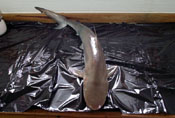
Common in bays and estuaries often entering rivers. Also found in offshore waters at depths of about 500 m, generally less than 100 m. Feeds mainly on small bony fishes, including wrasses, but also marine snails, squid and shrimp. Viviparous, with 2 to 6 young in a litter. Size at birth about 31 to 39 cm. Utilized salted or frozen for human consumption and processed into fish meal. Not dangerous (Ref. 9710).
Distinct pairing with embrace (Ref. 205). Viviparous, placental (Ref. 50449).
Compagno, L.J.V., 1984. FAO Species Catalogue. Vol. 4. Sharks of the world. An annotated and illustrated catalogue of shark species known to date. Part 2 - Carcharhiniformes. FAO Fish. Synop. 125(4/2):251-655. Rome: FAO. (Ref. 244)
Situación en la Lista Roja de la UICN (Ref. 130435: Version 2025-2 (Global))
Amenaza para el ser humano
Harmless
Usos humanos
Pesquerías: comercial
Herramientas
Informes especiales
Descargar XML
Fuentes de Internet
Estimaciones basadas en modelos
Temperatura preferida (Referencia
123201): 17.5 - 27.1, mean 24.2 °C (based on 80 cells).
Índice de diversidad filogenética (Referencia
82804): PD
50 = 0.5078 [Uniqueness, from 0.5 = low to 2.0 = high].
Bayesian length-weight: a=0.00219 (0.00145 - 0.00330), b=3.08 (2.96 - 3.20), in cm total length, based on LWR estimates for this species & Genus-body shape (Ref.
93245).
Nivel trófico (Referencia
69278): 4.0 ±0.2 se; based on diet studies.
Generation time: 3.7 ( na - na) years. Estimated as median ln(3)/K based on 2
growth studies.
Resiliencia (Referencia
120179): Muy bajo, población duplicada en un tiempo mínimo superior a 14 años (Fec=2; K=0.3-0.42).
Vulnerabilidad pesquera (Ref.
59153): Moderate to high vulnerability (51 of 100).
🛈
Nutrientes (Ref.
124155): Calcium = 8.95 [1.65, 47.15] mg/100g; Iron = 0.433 [0.104, 1.231] mg/100g; Protein = 22.2 [19.3, 24.6] %; Omega3 = 0.143 [0.058, 0.338] g/100g; Selenium = 38 [11, 110] μg/100g; VitaminA = 58.9 [20.5, 179.1] μg/100g; Zinc = 0.758 [0.366, 1.514] mg/100g (wet weight);