Elasmobranchi (squali e razze) (sharks and rays) >
Carcharhiniformes (Ground sharks) >
Carcharhinidae (Requiem sharks)
Etymology: Rhizoprionodon: rhiza (Gr.), root; prion (Gr.) saw; odon (Gr.), tooth, referring to teeth with serrated (saw-like) bases, or roots [replacement name for Rhizoprion Ogilby 1915, preoccupied by Rhizoprion Jourdan 1861 in mammals] (See ETYFish); porosus: Latin for pored or full of holes, referring to enlarged hyomandibular pores on both sides of head (See ETYFish).
More on author: Poey.
Ambiente: milieu / zona climatica / distribuzione batimetrica / gamma di distribuzione
Ecologia
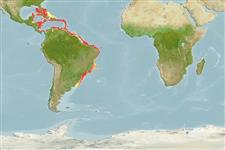
marino; acqua dolce; salmastro associati a barriera corallina; distribuzione batimetrica ? - 500 m (Ref. 244), usually ? - 100 m (Ref. 244). Tropical; 28°N - 40°S, 88°W - 32°W (Ref. 55194)
Western Atlantic: Caribbean, including the Bahamas, south to Uruguay. The separation of this species from Rhizoprionodon terraenovae whether as a distinct species or a representative of a southern subspecies is still uncertain and pending until detailed studies are commenced.
Lunghezza alla prima maturità / Dimensione / Peso / Età
Maturità: Lm 65.0, range 80 - ? cm
Max length : 113 cm TL maschio/sesso non determinato; (Ref. 111958); common length : 75.0 cm TL maschio/sesso non determinato; (Ref. 5217); peso massimo pubblicato: 7.5 kg (Ref. 111958)
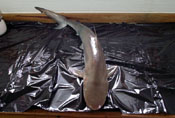
Common in bays and estuaries often entering rivers. Also found in offshore waters at depths of about 500 m, generally less than 100 m. Feeds mainly on small bony fishes, including wrasses, but also marine snails, squid and shrimp. Viviparous, with 2 to 6 young in a litter. Size at birth about 31 to 39 cm. Utilized salted or frozen for human consumption and processed into fish meal. Not dangerous (Ref. 9710).
Distinct pairing with embrace (Ref. 205). Viviparous, placental (Ref. 50449).
Compagno, L.J.V., 1984. FAO Species Catalogue. Vol. 4. Sharks of the world. An annotated and illustrated catalogue of shark species known to date. Part 2 - Carcharhiniformes. FAO Fish. Synop. 125(4/2):251-655. Rome: FAO. (Ref. 244)
Stato della Lista Rossa IUCN (Ref. 130435: Version 2025-2 (Global))
Minaccia per l'uomo
Harmless
Usi umani
Pesca: commerciale
Strumenti
Rapporti speciali
Scarica XML
Fonti Internet
Stime basate su modelli
Temperatura preferita (Fonte Biblio.
123201): 17.5 - 27.1, mean 24.2 °C (based on 80 cells).
Indice di diversità filogenetica (Fonte Biblio.
82804): PD
50 = 0.5078 [Uniqueness, from 0.5 = low to 2.0 = high].
Bayesian length-weight: a=0.00219 (0.00145 - 0.00330), b=3.08 (2.96 - 3.20), in cm total length, based on LWR estimates for this species & Genus-body shape (Ref.
93245).
Livello trofico (Fonte Biblio.
69278): 4.0 ±0.2 se; based on diet studies.
Generation time: 3.7 ( na - na) years. Estimated as median ln(3)/K based on 2
growth studies.
Resilienza (Fonte Biblio.
120179): Molto basso, tempo minimo di raddoppiamento della popolazione più di 14 anni (Fec=2; K=0.3-0.42).
Vulnerabilità della pesca (Ref.
59153): Moderate to high vulnerability (51 of 100).
🛈
Nutrienti (Ref.
124155): Calcium = 8.95 [1.65, 47.15] mg/100g; Iron = 0.433 [0.104, 1.231] mg/100g; Protein = 22.2 [19.3, 24.6] %; Omega3 = 0.143 [0.058, 0.338] g/100g; Selenium = 38 [11, 110] μg/100g; VitaminA = 58.9 [20.5, 179.1] μg/100g; Zinc = 0.758 [0.366, 1.514] mg/100g (wet weight);