Classificação / Nomes
Nomes comuns | Sinônimos | Catalog of Fishes(Gênero, Espécies) | ITIS | CoL | WoRMS | Cloffa
>
Siluriformes (Catfishes) >
Loricariidae (Armored catfishes) > Hypoptopomatinae
Etymology: Parotocinclus: Greek, para in the side of + greek, ous, otis = ear + Greek, kygklos, ou = a fish (Ref. 45335); robustus: The specific name is from the Latin adjective robustus, meaning robust, referring to the strong and robust appearance of the fish.
Meio ambiente: milieu / Zona climática / intervalo de profundidade / faixa de distribuição
Ecologia
; Água doce demersal. Tropical
South America: upper and middle Rio São Francico basin in Brazil.
Tamanho / Peso / Idade
Maturidade: Lm ? range ? - ? cm
Max length : 4.2 cm SL macho/indeterminado; (Ref. 91034)
Descrição suscinta
Chaves de identificação | Morfologia | Morfometria
Espinhos dorsais (total) : 1; Raios dorsais (total) : 7; Raios anais : 6. Distinguished from all species of Parotocinclus, except P. prata, by its abdomen
completely devoid of dermal plates between the pectoral girdle and the anus. Differs from P. prata by having the ventral surface of the head behind the lower lip smooth, without rugosities in adults (vs. ventral surface of the head behind the lower lip highly rugose in adult specimens), and by having the postrostral plate 4 contacting the infraorbitals 3 and 4 (vs. postrostral plate 4 not contacting the infraorbital series). Can be further diagnosed from most congeners, except P. arandai, P. bahiensis, P. prata, and P. spilurus, by having the rostral plate not visible ventrally on the snout tip (vs. rostral plate visible ventrally on the snout tip); and from most congeners, except P. spilurus, P. cearensis, P. prata, P. jumbo, P. spilosoma, and P. cesarpintoi, by having the pectoral girdle covered by skin medially and exposed and supporting odontodes only laterally (vs. pectoral girdle exposed and supporting odontodes both medially and laterally) (Ref. 91034).
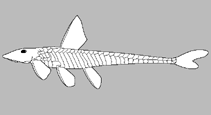
Body shape (shape guide): elongated.
Facultative air-breathing in the genus (Ref. 126274); Occurs in small to median-sized rivers with shallow water (0.4-1.5 m depth), slow to median-speed waterflow and clear to slightly turbid water running over a mixed bottom consisting of stones, gravel, sand and sometimes mud. Mostly found on the marginal vegetation (Ref. 91034).
Ciclo de vida ou comportamento de acasalamento
Maturidade | Reprodução | Desova | Ovos | Fecundidade | Larvas
Lehmann, A.P. and R.E. Reis, 2012. A new species of Parotocinclus (Siluriformes: Loricariidae) from the upper Rio São Francisco, Brazil. Zootaxa 3390:56-64. (Ref. 91034)
Status na Lista Vermelha da UICN (Ref. 130435: Version 2025-2 (Global))
Ameaça para os humanos
Harmless
Uso pelos humanos
Ferramentas
Relatórios especiais
Baixar XML
Fontes da internet
Estimativas baseadas em modelos
Índice de diversidade filogenética (Ref.
82804): PD
50 = 0.5000 [Uniqueness, from 0.5 = low to 2.0 = high].
Bayesian length-weight: a=0.00977 (0.00434 - 0.02202), b=3.06 (2.87 - 3.25), in cm total length, based on LWR estimates for this (Sub)family-body shape (Ref.
93245).
Resiliência (Ref.
120179): Elevada, tempo mínimo de duplicação da população menor que 15 meses (Preliminary K or Fecundity.).
Vulnerabilidade da pesca (Ref.
59153): Low vulnerability (10 of 100).
🛈