klasifikasi / Nama
Nama-nama umum | Sinonim (persamaan) | Catalog of Fishes(Marga, Jenis) | ITIS | CoL | WoRMS | Cloffa
>
Siluriformes (Catfishes) >
Loricariidae (Armored catfishes) > Hypoptopomatinae
Etymology: Parotocinclus: Greek, para in the side of + greek, ous, otis = ear + Greek, kygklos, ou = a fish (Ref. 45335); robustus: The specific name is from the Latin adjective robustus, meaning robust, referring to the strong and robust appearance of the fish.
Lingkungan: lingkungan / zona iklim / kisaran kedalaman / jangkauan distribusi
Ekologi
; air tawar dasar (demersal). Tropical
South America: upper and middle Rio São Francico basin in Brazil.
Ukuran / Berat / umur
Kematangan: Lm ? range ? - ? cm
Max length : 4.2 cm SL jantan/; (Ref. 91034)
deskripsi pendek
Kunci identifiaksi (pengenalan) | Morfologi | Morfometrik
Duri punggung (Keseluruhan (total)) : 1; duri punggung lunak (Keseluruhan (total)) : 7; Sirip dubur lunak: 6. Distinguished from all species of Parotocinclus, except P. prata, by its abdomen
completely devoid of dermal plates between the pectoral girdle and the anus. Differs from P. prata by having the ventral surface of the head behind the lower lip smooth, without rugosities in adults (vs. ventral surface of the head behind the lower lip highly rugose in adult specimens), and by having the postrostral plate 4 contacting the infraorbitals 3 and 4 (vs. postrostral plate 4 not contacting the infraorbital series). Can be further diagnosed from most congeners, except P. arandai, P. bahiensis, P. prata, and P. spilurus, by having the rostral plate not visible ventrally on the snout tip (vs. rostral plate visible ventrally on the snout tip); and from most congeners, except P. spilurus, P. cearensis, P. prata, P. jumbo, P. spilosoma, and P. cesarpintoi, by having the pectoral girdle covered by skin medially and exposed and supporting odontodes only laterally (vs. pectoral girdle exposed and supporting odontodes both medially and laterally) (Ref. 91034).
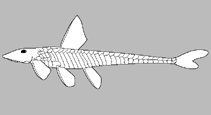
Body shape (shape guide): elongated.
Facultative air-breathing in the genus (Ref. 126274); Occurs in small to median-sized rivers with shallow water (0.4-1.5 m depth), slow to median-speed waterflow and clear to slightly turbid water running over a mixed bottom consisting of stones, gravel, sand and sometimes mud. Mostly found on the marginal vegetation (Ref. 91034).
Siklus hidup dan perilaku kawin
Kematangan | Reproduksi, perkembang biakan | Pemijahan | telur-telur | Fekunditas | Larva
Lehmann, A.P. and R.E. Reis, 2012. A new species of Parotocinclus (Siluriformes: Loricariidae) from the upper Rio São Francisco, Brazil. Zootaxa 3390:56-64. (Ref. 91034)
Status IUCN Red List (Ref. 130435: Version 2025-2 (Global))
ancaman kepada manusia
Harmless
penggunaan manusia
Alat, peralatan
laporan khas
muat turun XML
Sumber internet
Estimasi berdasarkan model
Indeks keanekaragaman filogenetik (Acuan
82804): PD
50 = 0.5000 [Uniqueness, from 0.5 = low to 2.0 = high].
Bayesian length-weight: a=0.00977 (0.00434 - 0.02202), b=3.06 (2.87 - 3.25), in cm total length, based on LWR estimates for this (Sub)family-body shape (Ref.
93245).
Daya lenting (Acuan
120179): Tinggi, Waktu penggandaan populasi minimum kurang dari 15 bulan (Preliminary K or Fecundity.).
Kerentanan Penangkapan Ikan (Ref.
59153): Low vulnerability (10 of 100).
🛈