Classificatie / Namen
Lokale namen | Synoniemen | Catalog of Fishes(Genus, Soort(en)) | ITIS | CoL | WoRMS | Cloffa
>
Siluriformes (Catfishes) >
Loricariidae (Armored catfishes) > Hypoptopomatinae
Etymology: Parotocinclus: Greek, para in the side of + greek, ous, otis = ear + Greek, kygklos, ou = a fish (Ref. 45335); robustus: The specific name is from the Latin adjective robustus, meaning robust, referring to the strong and robust appearance of the fish.
Milieu: milieu / Klimaatzone / Diepte / verspreidingsgebied
Ecologie
; zoet water demersaal. Tropical
South America: upper and middle Rio São Francico basin in Brazil.
Grootte / Gewicht / Leeftijd
Maturiteit: Lm ? range ? - ? cm
Max length : 4.2 cm SL mannelijk / geslacht onbekend; (Ref. 91034)
Korte beschrijving
Determinatiesleutels | Morfologie | Morfometrie
Dorsale stekels (totaal) : 1; Dorsale zachte stralen (totaal) : 7; Anale zachte stralen: 6. Distinguished from all species of Parotocinclus, except P. prata, by its abdomen
completely devoid of dermal plates between the pectoral girdle and the anus. Differs from P. prata by having the ventral surface of the head behind the lower lip smooth, without rugosities in adults (vs. ventral surface of the head behind the lower lip highly rugose in adult specimens), and by having the postrostral plate 4 contacting the infraorbitals 3 and 4 (vs. postrostral plate 4 not contacting the infraorbital series). Can be further diagnosed from most congeners, except P. arandai, P. bahiensis, P. prata, and P. spilurus, by having the rostral plate not visible ventrally on the snout tip (vs. rostral plate visible ventrally on the snout tip); and from most congeners, except P. spilurus, P. cearensis, P. prata, P. jumbo, P. spilosoma, and P. cesarpintoi, by having the pectoral girdle covered by skin medially and exposed and supporting odontodes only laterally (vs. pectoral girdle exposed and supporting odontodes both medially and laterally) (Ref. 91034).
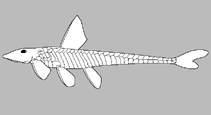
Body shape (shape guide): elongated.
Facultative air-breathing in the genus (Ref. 126274); Occurs in small to median-sized rivers with shallow water (0.4-1.5 m depth), slow to median-speed waterflow and clear to slightly turbid water running over a mixed bottom consisting of stones, gravel, sand and sometimes mud. Mostly found on the marginal vegetation (Ref. 91034).
Levenscyclus en paargedrag
Maturiteit | Voortplanting | Paaien | Eieren | Fecunditeit | Larven
Lehmann, A.P. and R.E. Reis, 2012. A new species of Parotocinclus (Siluriformes: Loricariidae) from the upper Rio São Francisco, Brazil. Zootaxa 3390:56-64. (Ref. 91034)
Status op de Rode Lijst van het IUCN (Ref. 130435: Version 2025-2 (Global))
Gevaar voor de mens
Harmless
Gebruik door de mens
Tools
Speciale rapporten
Download XML
Internetbronnen
Schattingen op basis van modellen
Fylogenetische diversiteitsindex (Ref.
82804): PD
50 = 0.5000 [Uniqueness, from 0.5 = low to 2.0 = high].
Bayesian length-weight: a=0.00977 (0.00434 - 0.02202), b=3.06 (2.87 - 3.25), in cm total length, based on LWR estimates for this (Sub)family-body shape (Ref.
93245).
Weerstandsvermogen (Ref.
120179): Hoog, minimale populatieverdubbelingstijd minder dan 15 maanden (Preliminary K or Fecundity.).
Kwetsbaarheid van de visserij (Ref.
59153): Low vulnerability (10 of 100).
🛈