>
Cichliformes (Cichlids, convict blennies) >
Cichlidae (Cichlids) > Cichlinae
Etymology: Cichla: Greek, kichle = wrasse (Ref. 45335).
Taxonomic Remarks
Redescription based on Venezuelan material in Machado-Allison (1971), as C. ocellaris.
Ambiente: milieu / zona climática / intervalo de profundidade / gama de distribuição
Ecologia
; Água doce bentopelágico; pH range: 5.5 - 6.5; não migratória (Ref. 126106). Tropical; 27°C - 29°C (Ref. 13614)
South America: Amazon River basin in the Negro and Uatumã River drainages; Orinoco River basin in tributaries of the Orinoco River in Venezuela and Colombia.
Comprimento na primeira maturidade / Tamanho / Peso / Idade
Maturidade: Lm 33.5, range 31 - 36 cm
Max length : 99.0 cm TL macho/indeterminado; (Ref. 40637); peso máx. Publicado: 12.2 kg (Ref. 40637)
Descrição breve
Chaves de identificação | Morfologia | Morfometria
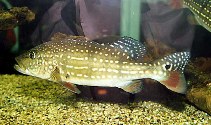
Diagnosis: A large, elongate species with small scales (E1 row scales 98-128, usually more than 110, vs. usually less than 110 in other species of Cichla). Postorbital band is present, entire, may be irregular but does not consist of scattered spots, vs. absent or present as scattered spots in other species of Cichla species. Lateral line is usually continuous. It is most similar to C. pinima and C. vazzoleri, sharing subadult to young adult color pattern including dark midlateral band and four rows of regularly arranged light spots along side, but light spots slightly elongate instead of round. It is different from C. pinima and C. vazzoleri in lacking dark lateral blotches with intensified light margins; vertical bars when expressed entire, never forming round blotches; ocellated blotches on dorsal side absent at all sizes; postorbital band entire (vs. expressed as scattered dark blotches); dark blotch associated with preopercle absent (present in C. vazzoleri); lateral line nearly always continuous (vs. usually discontinuous in C. vazzoleri) (Ref. 57716).
Body shape (shape guide): fusiform / normal.
Adults occupy deeper littoral areas in lagoons and sandy and rocky banks of the main river channel. They feed mainly on small fish (especially characids measuring <10 cm SL) (Ref. 26329, 27531). Oviparous (Ref. 205). Has been introduced to Florida and Texas, but is considered not established yet.
Ciclo de vida e comportamento de acasalamento
Maturidade | Reprodução | Desova | Ovos | Fecundidade | Larvas
Kullander, S.O., 2003. Cichlidae (Cichlids). p. 605-654. In R.E. Reis, S.O. Kullander and C.J. Ferraris, Jr. (eds.) Checklist of the Freshwater Fishes of South and Central America. Porto Alegre: EDIPUCRS, Brasil. (Ref. 36377)
Categoria na Lista Vermelha da IUCN (Ref. 130435: Version 2025-2 (Global))
Ameaça para o homem
Harmless
Utilização humana
Pescarias: espécies comerciais; Aquacultura: espécies comerciais; peixe desportivo: sim; Aquário: Espécies comerciais
Ferramentas
Relatórios especiais
Descarregue XML
Fontes da internet
Estimativas baseadas em modelos
Índice de diversidade filogenética (Ref.
82804): PD
50 = 0.5000 [Uniqueness, from 0.5 = low to 2.0 = high].
Bayesian length-weight: a=0.01122 (0.00512 - 0.02461), b=3.08 (2.91 - 3.25), in cm total length, based on LWR estimates for this Genus-body shape (Ref.
93245).
Nível Trófico (Ref.
69278): 4.5 ±0.5 se; based on diet studies.
Resiliência (Ref.
120179): Médio, tempo mínimo de duplicação da população 1,4 - 4,4 anos (K=0.16).
Vulnerabilidade da pesca (Ref.
59153): Moderate to high vulnerability (54 of 100).
🛈