>
Acipenseriformes (Sturgeons and paddlefishes) >
Acipenseridae (Sturgeons)
Etymology: Acipenser: Latin, acipenser = sturgeon, 1853 (Ref. 45335); gueldenstaedtii: Named for Johann Anton Güldenstädt (1745-1781).
Eponymy: Professor Johann Anton Gueldenstaedt (or Güldenstädt) (1745–1781) was a Baltic-German, born in Riga (Latvia), then part of the Russian Empire. [...] (Ref. 128868), visit book page.
Taxonomic Remarks
Acipenser colchicus was described as a subspecies of A. gueldenstaedti, then considered as a subspecies of A. persicus, and is now recognized as a species by some works. On the other end, other works suggest that A. persicus, which is similar to A. gueldenstaedti, is a synonym of the latter. We will wait that the taxonomoic situation gets more clarity before changing the list of valid species, which follows the World Sturgeon Conservation Society one. Check ECoF, IUCN and FAO for more details. Anyway in FishBase, it is possible to retrieve the information under the name that was used as valid in each publication.
Environnement : milieu / zone climatique / profondeur / gamme de distribution
Écologie
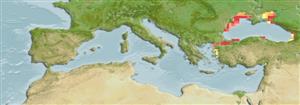
marin; eau douce; saumâtre démersal; anadrome (Ref. 138126); profondeur 2 - 100 m, usually 10 - 25 m. Temperate; 10°C - 20°C (Ref. 2059); 61°N - 35°N, 26°E - 54°E
Eurasia: Black Sea and Caspian Sea.
Longueur à la première maturité / Taille / Poids / Âge
Maturité: Lm ? range ? - ? cm
Max length : 236 cm TL mâle / non sexé; (Ref. 59043); common length : 145 cm TL mâle / non sexé; (Ref. 3561); poids max. publié: 115.0 kg (Ref. 6866); âge max. reporté: 46 années (Ref. 3561)
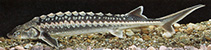
Épines dorsales (Total) : 0; Rayons mous dorsaux (Total) : 27 - 48; Rayons mous anaux: 16 - 35. Under the name A. g. colchicus. Lower lip not continuous, interrupted at center. Five rows of scutes: dorsal 7-19, lateral 24-44 on each side, ventral 6-13 on each side, with lines of smaller stellate bony plates between the dorsal and ventral rows. Color of back olivaceous grey, flanks lighter, and belly white.
Body shape (shape guide): elongated; Cross section: circular.
Anadromous and freshwater populations exist (Refs. 9953, 131118). At the sea, it occurs in shallow coastal and estuarine zones. In freshwaters, it inhabits deep parts of large rivers with moderate to swift current (Ref. 59043). Found mainly near the shore over sand and mud. Usually solitary, but swarms when hibernating or during spawning migrations. Occasionally forms schools (Ref. 3241). Feeds on benthic molluscs, crustaceans and small fishes. Spawns on stone or gravel bottom in large and deep rivers with strong current, 1-1.5 m/s (Ref. 59043). Mainly propagated through artificial reproduction.
Cycle de vie et comportement reproducteur
Maturité | Reproduction | Frai | Œufs | Fécondité | Larves
Under the name A. g. colchicus. Spawns in rivers. Natural spawning not extensive, maintained chiefly by artificial propagation. Enters rivers from April to June (a few in autumn).
Sokolov, L.I. and L.S. Berdicheskii, 1989. Acipenseridae. p. 150-153. In J. Holcík (ed.) The freshwater fishes of Europe. Vol. 1, Part II. General introduction to fishes Acipenseriformes. AULA-Verlag Wiesbaden. 469 p. (Ref. 9953)
Statut dans la liste rouge de l'IUCN (Ref. 130435: Version 2025-2 (Global))
Menace pour l'homme
Harmless
Utilisations par l'homme
Pêcheries: commercial; Aquaculture: commercial; Aquarium: Aquariums publics
Outils
Articles particuliers
Télécharger en XML
Sources Internet
Estimations basées sur des modèles
Température préférée (Réf.
123201): 10.7 - 15.9, mean 13.8 °C (based on 32 cells).
Indice de diversité phylogénétique (Réf.
82804): PD
50 = 0.5000 [Uniqueness, from 0.5 = low to 2.0 = high].
Bayesian length-weight: a=0.00417 (0.00258 - 0.00673), b=3.12 (2.99 - 3.25), in cm total length, based on LWR estimates for this species & Genus-body shape (Ref.
93245).
Niveau trophique (Réf.
69278): 3.3 ±0.1 se; based on diet studies.
Résilience (Réf.
120179): Très faible, temps minimum de doublement de population supérieur à 14 ans (tm=11; tmax=46; Fec = 26,000).
Vulnérabilité de la pêche (Ref.
59153): Very high vulnerability (87 of 100).
🛈
Vulnérabilité climatique (Ref.
125649): High vulnerability (62 of 100).
🛈
Nutriments (Ref.
124155): Calcium = 14.6 [8.4, 25.7] mg/100g; Iron = 0.247 [0.150, 0.396] mg/100g; Protein = 17.4 [14.9, 20.1] %; Omega3 = 0.342 [0.189, 0.611] g/100g; Selenium = 23.6 [12.0, 45.3] μg/100g; VitaminA = 5.63 [1.97, 16.00] μg/100g; Zinc = 0.512 [0.365, 0.722] mg/100g (wet weight);