>
Salmoniformes (Salmons) >
Salmonidae (Salmonids) > Coregoninae
Etymology: Coregonus: Greek, kore = pupils of the eye + Greek, gonia = angle (Ref. 45335).
More on author: Gmelin.
Miljö: miljö / Klimatzon / djupintervall / distributionsområde
Ekologi
marina; sötvatten; brackvatten bottenlevande; flodvandrande (Ref. 126106). Polar; 71°N - 44°N, 5°W - 133°W
Arctic Ocean basin, from Finland (lapland) to eastern Siberia, Alaska, and Canada eastward to Mackenzie drainage. Belongs to Coregonus clupeaformis complex (Ref. 27547).
Längd vid första mognad / Storlek / Vikt / Ålder
Könsmognad: Lm ?, range 17 - ? cm
Max length : 50.0 cm SL hane/ej könsbestämd; (Ref. 59043); common length : 32.8 cm TL hane/ej könsbestämd; (Ref. 12193); rapporterad maxålder: 14 år (Ref. 12193)
Kort beskrivning
Bestämningsnycklar | Morfologi | Morfometri
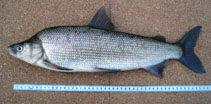
Taggstrålar i ryggfenan (totalt) : 0; Mjukstrålar i ryggfenan (totalt) : 11 - 13; Taggstrålar i analfenan: 0; Mjukstrålar i analfenan: 10 - 14; Ryggkotor: 58 - 63. Distinguished by the gill rakers that are longer than 20% of the interorbital width, 19 to 25 gill rakers (with modal counts of 22 or 23), and a pronounced hump behind the head in adults (Ref. 27547). Adipose fin well developed, often larger in males; axillary process present in pelvic fins (Ref. 27547). Dark brown to midnight blue above fading to silver on sides and wide beneath; no parr marks in young (Ref. 27547).
Body shape (shape guide): fusiform / normal.
Adults inhabit coastal waters near shore (Ref. 5723), lower reaches of rivers with slow current, large lakes with tributaries, floodplain lakes, deltas and estuaries, brackish waters (Ref. 59043). They migrate up to more than 1,200 km inland for spawning (Ref. 5723) and overwinter near river mouths (Ref. 5723). There are non-migratory freshwater populations. Adults feed mostly on mollusks, crustaceans and chironomid larvae (Ref. 28219).
Upstream spawning migrations may be extensive but some populations seldom venture far upstream and still others may never go to sea at all (Ref. 593). Mature adults migrate upstream as early as June to spawn in October. It is assumed that the young hatch in late winter and spring, subsequently moving downstream, to return as mature adults 4 to 6 years later (Ref. 27547).
Kottelat, M., 1997. European freshwater fishes. An heuristic checklist of the freshwater fishes of Europe (exclusive of former USSR), with an introduction for non-systematists and comments on nomenclature and conservation. Biologia, Bratislava, 52/Suppl. 5:1-271. (Ref. 13696)
Status på IUCN:s rödlista (Ref. 130435: Version 2025-2 (Global))
Hot mot människor
Harmless
Mänskliga användningsområden
Fiskeri: kommersiell; Vattenbruk: kommersiell
Verktyg
Särskilda rapporter
Ladda ner XML
Internet-källor
Uppskattningar baserade på modeller
Index för fylogenetisk mångfald (Ref.
82804): PD
50 = 0.5000 [Uniqueness, from 0.5 = low to 2.0 = high].
Bayesian length-weight: a=0.00550 (0.00331 - 0.00911), b=3.24 (3.10 - 3.38), in cm total length, based on LWR estimates for this species & Genus-body shape (Ref.
93245).
Trofisk nivå (Ref.
69278): 3.3 ±0.2 se; based on diet studies.
Resiliens (Ref.
120179): Låg, lägsta populationsfördubblingstid 4,5-14 år (tm=3-14; tmax=14; Fec=8,000).
Sårbarhet i fisket (Ref.
59153): Moderate to high vulnerability (52 of 100).
🛈
Näringsämnen (Ref.
124155): Calcium = 18.6 [9.7, 36.6] mg/100g; Iron = 0.418 [0.228, 0.771] mg/100g; Protein = 17.7 [16.6, 18.9] %; Omega3 = 0.619 [0.246, 1.731] g/100g; Selenium = 13.8 [5.7, 34.9] μg/100g; VitaminA = 7.09 [1.42, 38.51] μg/100g; Zinc = 0.481 [0.357, 0.661] mg/100g (wet weight);