>
Salmoniformes (Salmons) >
Salmonidae (Salmonids) > Coregoninae
Etymology: Coregonus: Greek, kore = pupils of the eye + Greek, gonia = angle (Ref. 45335).
More on author: Gmelin.
البيئة: الوسط / المنطقة المناخية / نطاق العمق / نطاق التوزيع
البيئة
بحري; المياه العذبة; مياه مخلوطة القاع; سمكة نهرية (Ref. 126106). Polar; 71°N - 44°N, 5°W - 133°W
Arctic Ocean basin, from Finland (lapland) to eastern Siberia, Alaska, and Canada eastward to Mackenzie drainage. Belongs to Coregonus clupeaformis complex (Ref. 27547).
الطول عند النضج الأول / الحجم / وزن / العمر
النضج: Lm ?, range 17 - ? cm
Max length : 50.0 cm SL ذكر/ مختلط الجنس; (Ref. 59043); common length : 32.8 cm TL ذكر/ مختلط الجنس; (Ref. 12193); العمر: 14 سنين (Ref. 12193)
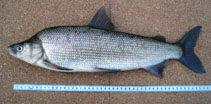
الأشواك الظهرية (المجموع) : 0; الأشعة الظهرية الناعمة (المجموع) : 11 - 13; شوكة شرجية: 0; أشعه شرجية لينه: 10 - 14; فقرات: 58 - 63. Distinguished by the gill rakers that are longer than 20% of the interorbital width, 19 to 25 gill rakers (with modal counts of 22 or 23), and a pronounced hump behind the head in adults (Ref. 27547). Adipose fin well developed, often larger in males; axillary process present in pelvic fins (Ref. 27547). Dark brown to midnight blue above fading to silver on sides and wide beneath; no parr marks in young (Ref. 27547).
Body shape (shape guide): fusiform / normal.
Adults inhabit coastal waters near shore (Ref. 5723), lower reaches of rivers with slow current, large lakes with tributaries, floodplain lakes, deltas and estuaries, brackish waters (Ref. 59043). They migrate up to more than 1,200 km inland for spawning (Ref. 5723) and overwinter near river mouths (Ref. 5723). There are non-migratory freshwater populations. Adults feed mostly on mollusks, crustaceans and chironomid larvae (Ref. 28219).
Upstream spawning migrations may be extensive but some populations seldom venture far upstream and still others may never go to sea at all (Ref. 593). Mature adults migrate upstream as early as June to spawn in October. It is assumed that the young hatch in late winter and spring, subsequently moving downstream, to return as mature adults 4 to 6 years later (Ref. 27547).
Kottelat, M., 1997. European freshwater fishes. An heuristic checklist of the freshwater fishes of Europe (exclusive of former USSR), with an introduction for non-systematists and comments on nomenclature and conservation. Biologia, Bratislava, 52/Suppl. 5:1-271. (Ref. 13696)
حالة القائمة الحمراء للاتحاد الدولي لحفظ الطبيعة والموارد الطبيعية (Ref. 130435: Version 2025-2 (Global))
استخدامات بشرية
مصائد: تجاري; الأستزراع المائي: تجاري
أدوات
تقارير خاصة
تنزيل XML
مصادر علي الأنترنت
تقديرات تستند إلى النماذج
مؤشر التنوع الشُعبي الوراثي (مرجع
82804): PD
50 = 0.5000 [Uniqueness, from 0.5 = low to 2.0 = high].
Bayesian length-weight: a=0.00550 (0.00331 - 0.00911), b=3.24 (3.10 - 3.38), in cm total length, based on LWR estimates for this species & Genus-body shape (Ref.
93245).
مستوى غذائي (مرجع
69278): 3.3 ±0.2 se; based on diet studies.
المرونه (مرجع
120179): منخفض, الحد الزمني الأدني لتضاعف عدد أفراد المجتمع 4.5-14 سنة (tm=3-14; tmax=14; Fec=8,000).
ضعف الصيد (Ref.
59153): Moderate to high vulnerability (52 of 100).
🛈
المغذيات (Ref.
124155): Calcium = 18.6 [9.7, 36.6] mg/100g; Iron = 0.418 [0.228, 0.771] mg/100g; Protein = 17.7 [16.6, 18.9] %; Omega3 = 0.619 [0.246, 1.731] g/100g; Selenium = 13.8 [5.7, 34.9] μg/100g; VitaminA = 7.09 [1.42, 38.51] μg/100g; Zinc = 0.481 [0.357, 0.661] mg/100g (wet weight);