Meio ambiente: milieu / Zona climática / intervalo de profundidade / faixa de distribuição
Ecologia
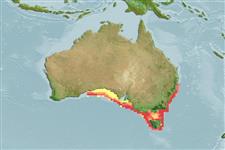
marinhas batidemersal; intervalo de profundidade 5 - 640 m (Ref. 6871), usually 100 - 300 m (Ref. 114953). Temperate; 30°S - 44°S, 126°E - 154°E (Ref. 114953)
Southeast Indian Ocean and Southwest Pacific: Australia (including New South Wales, South Australia, Victoria and Tasmania).
Tamanho / Peso / Idade
Maturidade: Lm ? range ? - ? cm
Max length : 47.0 cm TL macho/indeterminado; (Ref. 6871)
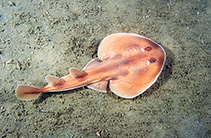
Found on sand or mud bottoms, occasionally near rocky reefs (Ref. 12951). Feeds on amphipods, shrimp, and worms (Ref. 12951). Produces 1-8 (normally 3) pups during each gestation. Both sexes mature at ca. 20-21 cm TL; born at 9-12 cm TL (Ref. 114953)
Ciclo de vida ou comportamento de acasalamento
Maturidade | Reprodução | Desova | Ovos | Fecundidade | Larvas
Paxton, J.R., D.F. Hoese, G.R. Allen and J.E. Hanley, 1989. Pisces. Petromyzontidae to Carangidae. Zoological Catalogue of Australia, Vol. 7. Australian Government Publishing Service, Canberra, 665 p. (Ref. 7300)
Status na Lista Vermelha da UICN (Ref. 130435: Version 2025-2 (Global))
Ameaça para os humanos
Harmless
Uso pelos humanos
Ferramentas
Relatórios especiais
Baixar XML
Fontes da internet
Estimativas baseadas em modelos
Temperatura preferida (Ref.
123201): 11.7 - 16.6, mean 14.2 °C (based on 82 cells).
Índice de diversidade filogenética (Ref.
82804): PD
50 = 0.5312 [Uniqueness, from 0.5 = low to 2.0 = high].
Bayesian length-weight: a=0.01175 (0.00470 - 0.02937), b=2.88 (2.66 - 3.10), in cm total length, based on LWR estimates for this (Sub)family-body shape (Ref.
93245).
Nível Trófico (Ref.
69278): 3.3 ±0.48 se; based on food items.
Resiliência (Ref.
120179): Baixo, tempo mínimo de duplicação da população 4,5 - 14 anos (Assuming fecundity<100).
Vulnerabilidade da pesca (Ref.
59153): Moderate vulnerability (37 of 100).
🛈