Environnement : milieu / zone climatique / profondeur / gamme de distribution
Écologie
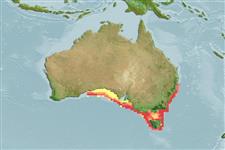
marin bathydémersal; profondeur 5 - 640 m (Ref. 6871), usually 100 - 300 m (Ref. 114953). Temperate; 30°S - 44°S, 126°E - 154°E (Ref. 114953)
Southeast Indian Ocean and Southwest Pacific: Australia (including New South Wales, South Australia, Victoria and Tasmania).
Taille / Poids / Âge
Maturité: Lm ? range ? - ? cm
Max length : 47.0 cm TL mâle / non sexé; (Ref. 6871)
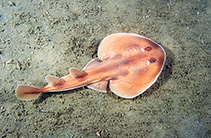
Found on sand or mud bottoms, occasionally near rocky reefs (Ref. 12951). Feeds on amphipods, shrimp, and worms (Ref. 12951). Produces 1-8 (normally 3) pups during each gestation. Both sexes mature at ca. 20-21 cm TL; born at 9-12 cm TL (Ref. 114953)
Cycle de vie et comportement reproducteur
Maturité | Reproduction | Frai | Œufs | Fécondité | Larves
Paxton, J.R., D.F. Hoese, G.R. Allen and J.E. Hanley, 1989. Pisces. Petromyzontidae to Carangidae. Zoological Catalogue of Australia, Vol. 7. Australian Government Publishing Service, Canberra, 665 p. (Ref. 7300)
Statut dans la liste rouge de l'IUCN (Ref. 130435: Version 2025-2 (Global))
Menace pour l'homme
Harmless
Utilisations par l'homme
Outils
Articles particuliers
Télécharger en XML
Sources Internet
Estimations basées sur des modèles
Température préférée (Réf.
123201): 11.7 - 16.6, mean 14.2 °C (based on 82 cells).
Indice de diversité phylogénétique (Réf.
82804): PD
50 = 0.5312 [Uniqueness, from 0.5 = low to 2.0 = high].
Bayesian length-weight: a=0.01175 (0.00470 - 0.02937), b=2.88 (2.66 - 3.10), in cm total length, based on LWR estimates for this (Sub)family-body shape (Ref.
93245).
Niveau trophique (Réf.
69278): 3.3 ±0.48 se; based on food items.
Résilience (Réf.
120179): Faible, temps minimum de doublement de population : 4,5 à 14 années (Assuming fecundity<100).
Vulnérabilité de la pêche (Ref.
59153): Moderate vulnerability (37 of 100).
🛈