Klassifizierung / Names
Namen | Synonyme | Catalog of Fishes(Gattung, Arten) | ITIS | CoL | WoRMS | Cloffa
Umwelt: Milieu / Klimazone / Tiefenbereich / Verbreitungsgebiet
Ökologie
seewasser bathydemersal; tiefenbereich 5 - 640 m (Ref. 6871), usually 100 - 300 m (Ref. 114953). Temperate; 30°S - 44°S, 126°E - 154°E (Ref. 114953)
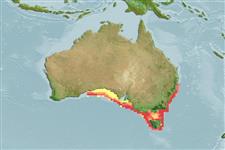
Southeast Indian Ocean and Southwest Pacific: Australia (including New South Wales, South Australia, Victoria and Tasmania).
Größe / Gewicht / Alter
Geschlechtsreife: Lm ? range ? - ? cm
Max length : 47.0 cm TL Männchen/unbestimmt; (Ref. 6871)
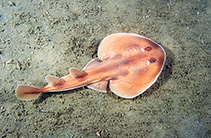
Found on sand or mud bottoms, occasionally near rocky reefs (Ref. 12951). Feeds on amphipods, shrimp, and worms (Ref. 12951). Produces 1-8 (normally 3) pups during each gestation. Both sexes mature at ca. 20-21 cm TL; born at 9-12 cm TL (Ref. 114953)
Lebenszyklus und Paarungsverhalten
Geschlechtsreife | Fortpflanzung | Ablaichen | Eier | Fruchtbarkeit | Larven
Paxton, J.R., D.F. Hoese, G.R. Allen and J.E. Hanley, 1989. Pisces. Petromyzontidae to Carangidae. Zoological Catalogue of Australia, Vol. 7. Australian Government Publishing Service, Canberra, 665 p. (Ref. 7300)
IUCN Rote Liste Status (Ref. 130435: Version 2025-2 (Global))
Bedrohung für Menschen
Harmless
Nutzung durch Menschen
Tools
Zusatzinformationen
Download XML
Internet Quellen
Schätzungen auf der Grundlage von Modellen
Bevorzugte Temperatur (Ref.
123201): 11.7 - 16.6, mean 14.2 °C (based on 82 cells).
Phylogenetischer Diversitätsindex (Ref.
82804): PD
50 = 0.5312 [Uniqueness, from 0.5 = low to 2.0 = high].
Bayesian length-weight: a=0.01175 (0.00470 - 0.02937), b=2.88 (2.66 - 3.10), in cm total length, based on LWR estimates for this (Sub)family-body shape (Ref.
93245).
Trophische Ebene (Ref.
69278): 3.3 ±0.48 se; based on food items.
Widerstandsfähigkeit (Ref.
120179): niedrig, Verdopplung der Population dauert 4,5 - 14 Jahre. (Assuming fecundity<100).
Anfälligkeit der Fischerei (Ref.
59153): Moderate vulnerability (37 of 100).
🛈