Ambiente: milieu / zona climatica / distribuzione batimetrica / gamma di distribuzione
Ecologia
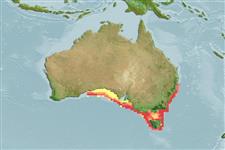
marino batidemersale; distribuzione batimetrica 5 - 640 m (Ref. 6871), usually 100 - 300 m (Ref. 114953). Temperate; 30°S - 44°S, 126°E - 154°E (Ref. 114953)
Southeast Indian Ocean and Southwest Pacific: Australia (including New South Wales, South Australia, Victoria and Tasmania).
Dimensione / Peso / Età
Maturità: Lm ? range ? - ? cm
Max length : 47.0 cm TL maschio/sesso non determinato; (Ref. 6871)
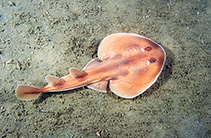
Found on sand or mud bottoms, occasionally near rocky reefs (Ref. 12951). Feeds on amphipods, shrimp, and worms (Ref. 12951). Produces 1-8 (normally 3) pups during each gestation. Both sexes mature at ca. 20-21 cm TL; born at 9-12 cm TL (Ref. 114953)
Ciclo vitale e comportamento di accoppiamento
Maturità | Riproduzione | Deposizione | Uova | Fecondità | Larve
Paxton, J.R., D.F. Hoese, G.R. Allen and J.E. Hanley, 1989. Pisces. Petromyzontidae to Carangidae. Zoological Catalogue of Australia, Vol. 7. Australian Government Publishing Service, Canberra, 665 p. (Ref. 7300)
Stato della Lista Rossa IUCN (Ref. 130435: Version 2025-2 (Global))
Minaccia per l'uomo
Harmless
Usi umani
Strumenti
Rapporti speciali
Scarica XML
Fonti Internet
Stime basate su modelli
Temperatura preferita (Fonte Biblio.
123201): 11.7 - 16.6, mean 14.2 °C (based on 82 cells).
Indice di diversità filogenetica (Fonte Biblio.
82804): PD
50 = 0.5312 [Uniqueness, from 0.5 = low to 2.0 = high].
Bayesian length-weight: a=0.01175 (0.00470 - 0.02937), b=2.88 (2.66 - 3.10), in cm total length, based on LWR estimates for this (Sub)family-body shape (Ref.
93245).
Livello trofico (Fonte Biblio.
69278): 3.3 ±0.48 se; based on food items.
Resilienza (Fonte Biblio.
120179): Basso, tempo minimo di raddoppiamento della popolazione 4.5 - 14 anni (Assuming fecundity<100).
Vulnerabilità della pesca (Ref.
59153): Moderate vulnerability (37 of 100).
🛈