>
Carangiformes (Jacks) >
Carangidae (Jacks and pompanos) > Naucratinae
Etymology: Naucrates: Greek, naykrates, -es, -es = supremacy in the sea (Ref. 45335).
More on author: Linnaeus.
Môi trường: môi trường / vùng khí hậu / Mức độ sâu / phạm vi phân phối
Sinh thái học
biển cùng sống ở rạn san hô; mức độ sâu 0 - 300 m (Ref. 86942). Subtropical; 61°N - 43°S, 180°W - 180°E
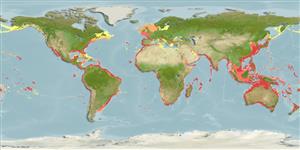
Circumtropical in tropical seas. Western Atlantic: Nova Scotia, Canada to Argentina (Ref. 7251). Eastern Atlantic: British Isles (rare vagrant), Norway and Bay of Biscay to Namibia, including the Mediterranean and Canary Islands. Eastern Pacific: Vancouver Island (British Columbia, Canada) to the Galapagos Islands (Ref. 2850) and Chile (Ref. 115205). Common throughout the Indian Ocean (Ref. 3197).
Bộ gần gũi / Khối lượng (Trọng lượng) / Tuổi
Chín muồi sinh dục: Lm ? range ? - ? cm
Max length : 70.0 cm TL con đực/không giới tính; (Ref. 5288); common length : 40.0 cm TL con đực/không giới tính; (Ref. 9626)
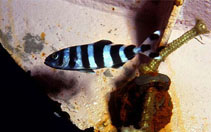
Các tia vây lưng cứng (tổng cộng) : 5 - 6; Các vây lưng mềm (tổng cộng) : 25 - 29; Tia cứng vây hậu môn: 3; Tia mềm vây hậu môn: 15 - 17. Body elongate, slender, and not strongly compressed; posterior end of upper jaw located at anterior rim of eye; dorsal fin with 4 or 5 spines followed by another spine and 25 to 29 soft rays (IV-V+I 25-29); lateral line without scutes; caudal peduncle with well developed fleshy keels and with dorsal and ventral peduncular fossae (Ref. 55763). Body dark to pale bluish, with 6-7 broad, dark bars; white tips on caudal lobes and on second dorsal and anal lobes (Ref. 3197).
Body shape (shape guide): fusiform / normal.
Oceanic species with a semi-obligate commensal relationship with sharks, rays, other bony fishes and turtles (Ref. 5217). Young are usually associated with jellyfish and drifting seaweed (Ref. 2850, 9563). Feed on scraps of host's left over, parasites and excrement; also on small fishes and invertebrates (Ref. 5288). Eggs are pelagic (Ref. 4233). Marketed fresh and salted or dried (Ref. 9283). Captured at the surface using hand nets (Ref. 26165).
Smith-Vaniz, W.F., J.-C. Quéro and M. Desoutter, 1990. Carangidae. p. 729-755. In J.C. Quero, J.C. Hureau, C. Karrer, A. Post and L. Saldanha (eds.) Check-list of the fishes of the eastern tropical Atlantic (CLOFETA). JNICT, Lisbon; SEI, Paris; and UNESCO, Paris. Vol. 2. (Ref. 7097)
Tình trạng Sách đỏ IUCN (Ref. 130435: Version 2025-2 (Global))
Mối đe dọa đối với con người
Harmless
Sử dụng của con người
Các nghề cá: buôn bán nhỏ; cá để chơi: đúng; Bể nuôi cá: Bể cá công cộng
Các công cụ
Báo cáo đặc biệt
Tải xuống XML
Các nguồn internet
Ước tính dựa trên mô hình
Nhiệt độ ưa thích (Tài liệu tham khảo
123201): 7.9 - 28.1, mean 20.9 °C (based on 3025 cells).
Chỉ số đa dạng phát sinh loài (Tài liệu tham khảo
82804): PD
50 = 1.0000 [Uniqueness, from 0.5 = low to 2.0 = high].
Bayesian length-weight: a=0.01413 (0.00656 - 0.03042), b=2.93 (2.74 - 3.12), in cm total length, based on LWR estimates for this species & (Sub)family-body (Ref.
93245).
Mức dinh dưỡng (Tài liệu tham khảo
69278): 3.4 ±0.43 se; based on food items.
Thích nghi nhanh (Tài liệu tham khảo
120179): Chiêù cao, thời gian nhân đôi của chủng quần tối thiểu là dưới 15 tháng (K=2.15-6.8.;).
Sự dễ bị tổn thương của nghề đánh cá (Ref.
59153): Moderate to high vulnerability (48 of 100).
🛈
Chất dinh dưỡng (Ref.
124155): Calcium = 53.5 [24.2, 150.1] mg/100g; Iron = 1.83 [0.82, 3.87] mg/100g; Protein = 20.4 [18.9, 21.9] %; Omega3 = 0.235 [0.085, 0.623] g/100g; Selenium = 61.3 [21.5, 188.7] μg/100g; VitaminA = 7.63 [1.58, 39.34] μg/100g; Zinc = 0.869 [0.481, 1.541] mg/100g (wet weight);