>
Carangiformes (Jacks) >
Carangidae (Jacks and pompanos) > Naucratinae
Etymology: Naucrates: Greek, naykrates, -es, -es = supremacy in the sea (Ref. 45335).
More on author: Linnaeus.
Ambiente: milieu / zona climatica / distribuzione batimetrica / gamma di distribuzione
Ecologia
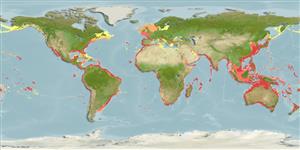
marino associati a barriera corallina; distribuzione batimetrica 0 - 300 m (Ref. 86942). Subtropical; 61°N - 43°S, 180°W - 180°E
Circumtropical in tropical seas. Western Atlantic: Nova Scotia, Canada to Argentina (Ref. 7251). Eastern Atlantic: British Isles (rare vagrant), Norway and Bay of Biscay to Namibia, including the Mediterranean and Canary Islands. Eastern Pacific: Vancouver Island (British Columbia, Canada) to the Galapagos Islands (Ref. 2850) and Chile (Ref. 115205). Common throughout the Indian Ocean (Ref. 3197).
Dimensione / Peso / Età
Maturità: Lm ? range ? - ? cm
Max length : 70.0 cm TL maschio/sesso non determinato; (Ref. 5288); common length : 40.0 cm TL maschio/sesso non determinato; (Ref. 9626)
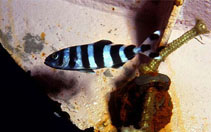
Spine dorsali (totale) : 5 - 6; Raggi dorsali molli (totale) : 25 - 29; Spine anali: 3; Raggi anali molli: 15 - 17. Body elongate, slender, and not strongly compressed; posterior end of upper jaw located at anterior rim of eye; dorsal fin with 4 or 5 spines followed by another spine and 25 to 29 soft rays (IV-V+I 25-29); lateral line without scutes; caudal peduncle with well developed fleshy keels and with dorsal and ventral peduncular fossae (Ref. 55763). Body dark to pale bluish, with 6-7 broad, dark bars; white tips on caudal lobes and on second dorsal and anal lobes (Ref. 3197).
Body shape (shape guide): fusiform / normal.
Oceanic species with a semi-obligate commensal relationship with sharks, rays, other bony fishes and turtles (Ref. 5217). Young are usually associated with jellyfish and drifting seaweed (Ref. 2850, 9563). Feed on scraps of host's left over, parasites and excrement; also on small fishes and invertebrates (Ref. 5288). Eggs are pelagic (Ref. 4233). Marketed fresh and salted or dried (Ref. 9283). Captured at the surface using hand nets (Ref. 26165).
Ciclo vitale e comportamento di accoppiamento
Maturità | Riproduzione | Deposizione | Uova | Fecondità | Larve
Smith-Vaniz, W.F., J.-C. Quéro and M. Desoutter, 1990. Carangidae. p. 729-755. In J.C. Quero, J.C. Hureau, C. Karrer, A. Post and L. Saldanha (eds.) Check-list of the fishes of the eastern tropical Atlantic (CLOFETA). JNICT, Lisbon; SEI, Paris; and UNESCO, Paris. Vol. 2. (Ref. 7097)
Stato della Lista Rossa IUCN (Ref. 130435: Version 2025-2 (Global))
Minaccia per l'uomo
Harmless
Usi umani
Pesca: scarso interesse commerciale; Pesce da pesca sportiva: si; Acquario: Acquari pubblici
Strumenti
Rapporti speciali
Scarica XML
Fonti Internet
Stime basate su modelli
Temperatura preferita (Fonte Biblio.
123201): 7.9 - 28.1, mean 20.9 °C (based on 3025 cells).
Indice di diversità filogenetica (Fonte Biblio.
82804): PD
50 = 1.0000 [Uniqueness, from 0.5 = low to 2.0 = high].
Bayesian length-weight: a=0.01413 (0.00656 - 0.03042), b=2.93 (2.74 - 3.12), in cm total length, based on LWR estimates for this species & (Sub)family-body (Ref.
93245).
Livello trofico (Fonte Biblio.
69278): 3.4 ±0.43 se; based on food items.
Resilienza (Fonte Biblio.
120179): Alto, tempo minimo di raddoppiamento della popolazione meno di 15 mesi (K=2.15-6.8.;).
Vulnerabilità della pesca (Ref.
59153): Moderate to high vulnerability (48 of 100).
🛈
Nutrienti (Ref.
124155): Calcium = 53.5 [24.2, 150.1] mg/100g; Iron = 1.83 [0.82, 3.87] mg/100g; Protein = 20.4 [18.9, 21.9] %; Omega3 = 0.235 [0.085, 0.623] g/100g; Selenium = 61.3 [21.5, 188.7] μg/100g; VitaminA = 7.63 [1.58, 39.34] μg/100g; Zinc = 0.869 [0.481, 1.541] mg/100g (wet weight);