Lớp phụ Cá sụn (cá mập và cá đuối) (sharks and rays) >
Myliobatiformes (Stingrays) >
Dasyatidae (Stingrays) > Dasyatinae
Eponymy: The original description has no etymology but, though the binomial looks as if it could be an eponym, it is merely a translation: aka is Japanese for red, referring to its bright orange-red underside and jei is Japanese for ray/skate. (Ref. 128868), visit book page.
More on authors: Müller & Henle.
Môi trường: môi trường / vùng khí hậu / Mức độ sâu / phạm vi phân phối
Sinh thái học
biển; thuộc về nước lợ gần đáy; Ở đại duơng, biển (Ref. 51243); mức độ sâu 10 - 50 m (Ref. 114953). Subtropical; 43°N - 23°N (Ref. 114953)
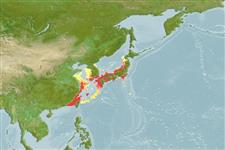
Northwest Pacific: central China to northern Japan.
Chiều dài lúc trưởng thành đầu tiên / Bộ gần gũi / Khối lượng (Trọng lượng) / Tuổi
Chín muồi sinh dục: Lm 44.0 range ? - ? cm
Max length : 200 cm TL con đực/không giới tính; (Ref. 637); common length : 100.0 cm TL con đực/không giới tính; (Ref. 637); Khối lượng cực đại được công bố: 10.7 kg (Ref. 40637)
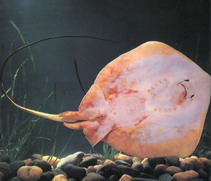
Disc rhomboid, anterior margin straight, posterior margin convex. Snout triangular and slightly produced. dorsal keel present on tail. Adults with small spines on disc and posterior part of tail. Brown dorsally and some with orangish pectoral fin margins, in front of eyes, behind spiracles, on the sides of the tail just anterior to the sting. Ventrum orangish red.
Body shape (shape guide): other.
Found in coral reefs and estuarine areas, on sand and mud bottoms (Ref. 12951, 11230). Feeds on small fishes and crustaceans (Ref. 9840). Ovoviviparous with litters of only 1 pup (Ref. 114953) while earlier estimates indicated production of up to 10 in a litter (Ref. 12951). Caught occasionally by bottom trawl fisheries operating inshore. Utilized for its meat but of limited value due to its small size (Ref.58048). Served in 'miso' soup, hard boiled with seasonings, or for 'kamaboko' material (Ref. 637).
Exhibit ovoviparity (aplacental viviparity), with embryos feeding initially on yolk, then receiving additional nourishment from the mother by indirect absorption of uterine fluid enriched with mucus, fat or protein through specialised structures (Ref. 50449). Distinct pairing with embrace (Ref. 205).
Last, P.R., W.T. White, M.R. de Carvalho, B. Séret, M.F.W. Stehmann and G.J.P. Naylor, 2016. Rays of the world. CSIRO Publishing, Comstock Publishing Associates. i-ix + 1-790. (Ref. 114953)
Tình trạng Sách đỏ IUCN (Ref. 130435: Version 2025-2 (Global))
Mối đe dọa đối với con người
Sử dụng của con người
Các nghề cá: tính thương mại; cá để chơi: đúng; Bể nuôi cá: Tính thương mại
Các công cụ
Báo cáo đặc biệt
Tải xuống XML
Các nguồn internet
Ước tính dựa trên mô hình
Nhiệt độ ưa thích (Tài liệu tham khảo
123201): 21.4 - 29, mean 28.1 °C (based on 510 cells).
Chỉ số đa dạng phát sinh loài (Tài liệu tham khảo
82804): PD
50 = 0.5005 [Uniqueness, from 0.5 = low to 2.0 = high].
Bayesian length-weight: a=0.00447 (0.00189 - 0.01058), b=3.12 (2.92 - 3.32), in cm total length, based on LWR estimates for this (Sub)family-body shape (Ref.
93245).
Mức dinh dưỡng (Tài liệu tham khảo
69278): 3.8 ±0.58 se; based on food items.
Thích nghi nhanh (Tài liệu tham khảo
120179): thấp, thời gian nhân đôi của chủng quần tối thiểu là 4.5 - 14 năm (K=0.1; Fec=1).
Sự dễ bị tổn thương của nghề đánh cá (Ref.
59153): Very high vulnerability (90 of 100).
🛈
Sự dễ bị tổn thương của khí hậu (Ref.
125649): Very high vulnerability (87 of 100).
🛈