Ikan bertulang rawan (sharks and rays) >
Myliobatiformes (Stingrays) >
Dasyatidae (Stingrays) > Dasyatinae
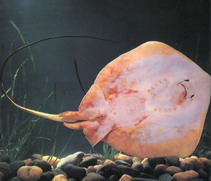
Eponymy: The original description has no etymology but, though the binomial looks as if it could be an eponym, it is merely a translation: aka is Japanese for red, referring to its bright orange-red underside and jei is Japanese for ray/skate. (Ref. 128868), visit book page.
More on authors: Müller & Henle.
Lingkungan: lingkungan / zona iklim / kisaran kedalaman / jangkauan distribusi
Ekologi
laut; payau dasar (demersal); oceanodromus (Ref. 51243); kisaran kedalaman 10 - 50 m (Ref. 114953). Subtropical; 43°N - 23°N (Ref. 114953)
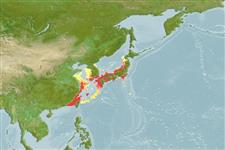
Northwest Pacific: central China to northern Japan.
Panjang pada saat jatuh tempo pertama / Ukuran / Berat / umur
Kematangan: Lm 44.0 range ? - ? cm
Max length : 200 cm TL jantan/; (Ref. 637); common length : 100.0 cm TL jantan/; (Ref. 637); Berat maksimum terpublikasi: 10.7 kg (Ref. 40637)
Disc rhomboid, anterior margin straight, posterior margin convex. Snout triangular and slightly produced. dorsal keel present on tail. Adults with small spines on disc and posterior part of tail. Brown dorsally and some with orangish pectoral fin margins, in front of eyes, behind spiracles, on the sides of the tail just anterior to the sting. Ventrum orangish red.
Body shape (shape guide): other.
Found in coral reefs and estuarine areas, on sand and mud bottoms (Ref. 12951, 11230). Feeds on small fishes and crustaceans (Ref. 9840). Ovoviviparous with litters of only 1 pup (Ref. 114953) while earlier estimates indicated production of up to 10 in a litter (Ref. 12951). Caught occasionally by bottom trawl fisheries operating inshore. Utilized for its meat but of limited value due to its small size (Ref.58048). Served in 'miso' soup, hard boiled with seasonings, or for 'kamaboko' material (Ref. 637).
Exhibit ovoviparity (aplacental viviparity), with embryos feeding initially on yolk, then receiving additional nourishment from the mother by indirect absorption of uterine fluid enriched with mucus, fat or protein through specialised structures (Ref. 50449). Distinct pairing with embrace (Ref. 205).
Last, P.R., W.T. White, M.R. de Carvalho, B. Séret, M.F.W. Stehmann and G.J.P. Naylor, 2016. Rays of the world. CSIRO Publishing, Comstock Publishing Associates. i-ix + 1-790. (Ref. 114953)
Status IUCN Red List (Ref. 130435: Version 2025-2 (Global))
penggunaan manusia
Perikanan: komersial; Ikan buruan: ya; Akuarium: Komersial
Alat, peralatan
laporan khas
muat turun XML
Sumber internet
Estimasi berdasarkan model
Suhu yang disukai (Acuan
123201): 21.4 - 29, mean 28.1 °C (based on 510 cells).
Indeks keanekaragaman filogenetik (Acuan
82804): PD
50 = 0.5005 [Uniqueness, from 0.5 = low to 2.0 = high].
Bayesian length-weight: a=0.00447 (0.00189 - 0.01058), b=3.12 (2.92 - 3.32), in cm total length, based on LWR estimates for this (Sub)family-body shape (Ref.
93245).
Tingkat Trofik (Acuan
69278): 3.8 ±0.58 se; based on food items.
Daya lenting (Acuan
120179): Rendah, Waktu penggandaan populasi minimum 4.5 - 14 tahun (K=0.1; Fec=1).
Kerentanan Penangkapan Ikan (Ref.
59153): Very high vulnerability (90 of 100).
🛈
Kerentanan Iklim (Ref.
125649): Very high vulnerability (87 of 100).
🛈