分類 / 名前
共通名の | 類義語 | Catalog of Fishes(部類, 種) | ITIS | CoL | WoRMS | Cloffa
板鰓亜鋼(サメとエイ類) (sharks and rays) >
Myliobatiformes (Stingrays) >
Dasyatidae (Stingrays) > Dasyatinae
Eponymy: The original description has no etymology but, though the binomial looks as if it could be an eponym, it is merely a translation: aka is Japanese for red, referring to its bright orange-red underside and jei is Japanese for ray/skate. (Ref. 128868), visit book page.
More on authors: Müller & Henle.
環境:環境 / 気候帯 / 深さの範囲 / 分布範囲
生態学
海; 汽水性の 底生の; 海洋回遊性 (Ref. 51243); 深さの範囲 10 - 50 m (Ref. 114953). Subtropical; 43°N - 23°N (Ref. 114953)
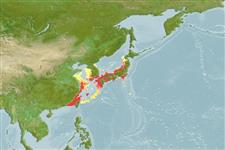
Northwest Pacific: central China to northern Japan.
初回成熟時の長さ / サイズ / 重さ / 年齢
成熟: Lm 44.0 range ? - ? cm
Max length : 200 cm TL オス/雌雄の選別がない; (Ref. 637); common length : 100.0 cm TL オス/雌雄の選別がない; (Ref. 637); 最大公表体重: 10.7 kg (Ref. 40637)
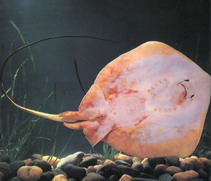
Disc rhomboid, anterior margin straight, posterior margin convex. Snout triangular and slightly produced. dorsal keel present on tail. Adults with small spines on disc and posterior part of tail. Brown dorsally and some with orangish pectoral fin margins, in front of eyes, behind spiracles, on the sides of the tail just anterior to the sting. Ventrum orangish red.
Body shape (shape guide): other.
Found in coral reefs and estuarine areas, on sand and mud bottoms (Ref. 12951, 11230). Feeds on small fishes and crustaceans (Ref. 9840). Ovoviviparous with litters of only 1 pup (Ref. 114953) while earlier estimates indicated production of up to 10 in a litter (Ref. 12951). Caught occasionally by bottom trawl fisheries operating inshore. Utilized for its meat but of limited value due to its small size (Ref.58048). Served in 'miso' soup, hard boiled with seasonings, or for 'kamaboko' material (Ref. 637).
ライフサイクルと交尾行動
成熟 | 繁殖 | 放精 | 卵 | 生産力 | 幼生
Exhibit ovoviparity (aplacental viviparity), with embryos feeding initially on yolk, then receiving additional nourishment from the mother by indirect absorption of uterine fluid enriched with mucus, fat or protein through specialised structures (Ref. 50449). Distinct pairing with embrace (Ref. 205).
Last, P.R., W.T. White, M.R. de Carvalho, B. Séret, M.F.W. Stehmann and G.J.P. Naylor, 2016. Rays of the world. CSIRO Publishing, Comstock Publishing Associates. i-ix + 1-790. (Ref. 114953)
IUCNのレッドリストの状況は (Ref. 130435: Version 2025-2 (Global))
人間の用途
水産業: 商業; ゲームフィッシュ: はい; 水族館・水槽: 商業
用具
特記事項
XMLをダウンロードして下さい
インターネットの情報源
モデルに基づく推定値
好ましい温度 (参照
123201): 21.4 - 29, mean 28.1 °C (based on 510 cells).
系統多様性指数 (参照
82804): PD
50 = 0.5005 [Uniqueness, from 0.5 = low to 2.0 = high].
Bayesian length-weight: a=0.00447 (0.00189 - 0.01058), b=3.12 (2.92 - 3.32), in cm total length, based on LWR estimates for this (Sub)family-body shape (Ref.
93245).
栄養段階 (参照
69278): 3.8 ±0.58 se; based on food items.
回復力 (参照
120179): 低い, 4.5年~14年の倍増期間の最小個体群 (K=0.1; Fec=1).
漁業の脆弱性 (Ref.
59153): Very high vulnerability (90 of 100).
🛈
気候脆弱性 (Ref.
125649): Very high vulnerability (87 of 100).
🛈