>
Ophidiiformes (Cusk eels) >
Bythitidae (Livebearing brotulas)
Eponymy: Cristoforo Bellotti (1823–1919) was an Italian ichthyologist and palaeontologist, who was also very interested in the breeding of silkworms. [...] (Ref. 128868), visit book page.
Taxonomic Remarks
Type species of genus
Ambiente: milieu / zona climática / intervalo de profundidade / gama de distribuição
Ecologia
marinhas batidemersal; intervalo de profundidade 30 - 569 m (Ref. 56504). Deep-water
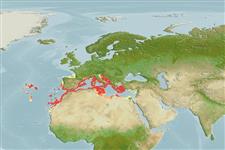
Mediterranean Sea and subtropical Eastern Atlantic: Greece, Adriatic Sea, Tyrrhenian Sea, south Portugal and off Madeira (Ref. 4758, Ref. 13359). Also one specimen from 29°50.2'N, 28°29.8'W (Ref. 4758). Subtropical western Atlantic specimens may be this species (Ref. 34024).
Tamanho / Peso / Idade
Maturidade: Lm ? range ? - ? cm
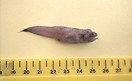
Max length : 6.5 cm SL macho/indeterminado; (Ref. 6526)
Descrição breve
Chaves de identificação | Morfologia | Morfometria
Espinhos dorsais (total) : 0; Raios dorsais moles (total) : 81 - 96; Espinhos anais: 0; Raios anais moles: 64 - 76. Mouth is large, with strong jaws; six caudal rays (Ref. 13359). Swim-bladder present; pelvic fins absent; several sharp spines present at lower angle of opercle; precaudal vertebrae 10 to 12; caudal fin broadly joined to dorsal and anal fins; male intromittent organ lacking ossified parts; females have genital pores (Ref. 34024).
Body shape (shape guide): fusiform / normal.
Depth range from 30-500 m (Ref. 6526) and from 460-569 m in the eastern Ionian Sea (Ref. 56504). The food of Bellottia apoda appears to be a mixture of planktonic and benthic preys (Ref. 13359). Viviparous (Ref. 6526). Uncommon species (Ref. 34024), but it is not so rare as it seemed in the Adriatic Sea (Ref. 13359).
Ciclo de vida e comportamento de acasalamento
Maturidade | Reprodução | Desova | Ovos | Fecundidade | Larvas
Nielsen, J.G., D.M. Cohen, D.F. Markle and C.R. Robins, 1999. Ophidiiform fishes of the world (Order Ophidiiformes). An annotated and illustrated catalogue of pearlfishes, cusk-eels, brotulas and other ophidiiform fishes known to date. FAO Fish. Synop. 125(18):178p. Rome: FAO. (Ref. 34024)
Categoria na Lista Vermelha da IUCN (Ref. 130435: Version 2025-2 (Global))
Ameaça para o homem
Harmless
Utilização humana
Pescarias: sem interesse
Ferramentas
Relatórios especiais
Descarregue XML
Fontes da internet
Estimativas baseadas em modelos
Temperatura preferida (Ref.
123201): 13.2 - 16.1, mean 14.6 °C (based on 142 cells).
Índice de diversidade filogenética (Ref.
82804): PD
50 = 0.5312 [Uniqueness, from 0.5 = low to 2.0 = high].
Bayesian length-weight: a=0.01122 (0.00514 - 0.02450), b=3.04 (2.87 - 3.21), in cm total length, based on all LWR estimates for this body shape (Ref.
93245).
Nível Trófico (Ref.
69278): 3.4 ±0.50 se; based on food items.
Resiliência (Ref.
120179): Baixo, tempo mínimo de duplicação da população 4,5 - 14 anos (Fec=30-180).
Vulnerabilidade da pesca (Ref.
59153): Low vulnerability (10 of 100).
🛈
Nutrientes (Ref.
124155): Calcium = 68.1 [12.7, 259.9] mg/100g; Iron = 0.851 [0.294, 2.099] mg/100g; Protein = 16.3 [13.7, 18.7] %; Omega3 = 0.631 [0.223, 1.817] g/100g; Selenium = 8.69 [2.34, 30.20] μg/100g; VitaminA = 19.9 [4.1, 89.6] μg/100g; Zinc = 0.739 [0.370, 1.422] mg/100g (wet weight);