Lớp phụ Cá sụn (cá mập và cá đuối) (sharks and rays) >
Squatiniformes (Angel sharks) >
Squatinidae (Angel sharks)
Etymology: Squatina: Latin for skate, which angel sharks superficially resemble, presumably tautonymous with Squalus squatina Linnaeus 1758 (no species mentioned) (See ETYFish); californica: -ica (L.), belonging to: California (USA), referring to type locality in San Francisco Bay (See ETYFish).
More on author: Ayres.
Taxonomic Remarks
It is sympatric with S. armata.
Môi trường: môi trường / vùng khí hậu / Mức độ sâu / phạm vi phân phối
Sinh thái học
biển gần đáy; mức độ sâu 3 - 205 m (Ref. 9253), usually 3 - 46 m (Ref. 54903). Subtropical; 56°N - 4°S, 134°W - 77°W
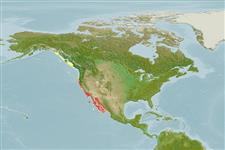
Eastern Pacific: Canada to Gulf of California, south to northern Peru.
Chiều dài lúc trưởng thành đầu tiên / Bộ gần gũi / Khối lượng (Trọng lượng) / Tuổi
Chín muồi sinh dục: Lm 97.0, range 86 - 108 cm
Max length : 152 cm TL con đực/không giới tính; (Ref. 247); Tuổi cực đại được báo cáo: 35 các năm (Ref. 6147)
Mô tả ngắn gọn
Khóa để định loại | Hình thái học | Sinh trắc học
Các tia vây lưng cứng (tổng cộng) : 0; Tia cứng vây hậu môn: 0.
Body shape (shape guide): other.
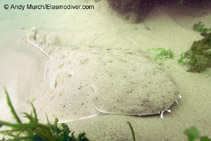
Found on the continental shelf and littoral areas (Ref. 247).A sluggish and inactive species that buries itself in sand or mud (Ref. 247). Also found around rocks, heads of submarine canyons, and sometimes near kelp forests (Ref. 247). Feeds on bottom and epibenthic fishes, including croakers, California halibut, and squid (Ref. 247). Ovoviviparous (Ref. 50449). Can whip up its head and snap very quickly when touched, provoked, harassed, or speared, and can inflict painful lacerations (Ref. 247).
Ovoviviparous, embryos feed solely on yolk (Ref. 50449).
Compagno, L.J.V., 1984. FAO Species Catalogue. Vol. 4. Sharks of the world. An annotated and illustrated catalogue of shark species known to date. Part 1 - Hexanchiformes to Lamniformes. FAO Fish. Synop. 125(4/1):1-249. Rome, FAO. (Ref. 247)
Tình trạng Sách đỏ IUCN (Ref. 130435: Version 2025-2 (Global))
Mối đe dọa đối với con người
Sử dụng của con người
Các nghề cá: tính thương mại
Các công cụ
Báo cáo đặc biệt
Tải xuống XML
Các nguồn internet
Ước tính dựa trên mô hình
Nhiệt độ ưa thích (Tài liệu tham khảo
123201): 12.5 - 25.9, mean 21 °C (based on 60 cells).
Chỉ số đa dạng phát sinh loài (Tài liệu tham khảo
82804): PD
50 = 0.5000 [Uniqueness, from 0.5 = low to 2.0 = high].
Bayesian length-weight: a=0.00661 (0.00287 - 0.01523), b=3.07 (2.88 - 3.26), in cm total length, based on LWR estimates for this Genus-body shape (Ref.
93245).
Mức dinh dưỡng (Tài liệu tham khảo
69278): 4.1 ±0.4 se; based on diet studies.
Thích nghi nhanh (Tài liệu tham khảo
120179): Rất thấp, thời gian nhân đôi của chủng quần tối thiểu là hơn 14 năm (K=0.15-0.16; tm=8-13; tmax=35; Fec=6).
Sự dễ bị tổn thương của nghề đánh cá (Ref.
59153): High to very high vulnerability (67 of 100).
🛈
Chất dinh dưỡng (Ref.
124155): Calcium = 17.5 [3.6, 86.6] mg/100g; Iron = 0.795 [0.206, 2.275] mg/100g; Protein = 19.9 [17.8, 21.8] %; Omega3 = 0.363 [0.162, 0.801] g/100g; Selenium = 26.5 [7.5, 76.0] μg/100g; VitaminA = 9.99 [3.53, 27.74] μg/100g; Zinc = 0.421 [0.203, 0.760] mg/100g (wet weight);