Elasmobranquios (tiburones y rayas) (sharks and rays) >
Squatiniformes (Angel sharks) >
Squatinidae (Angel sharks)
Etymology: Squatina: Latin for skate, which angel sharks superficially resemble, presumably tautonymous with Squalus squatina Linnaeus 1758 (no species mentioned) (See ETYFish); californica: -ica (L.), belonging to: California (USA), referring to type locality in San Francisco Bay (See ETYFish).
More on author: Ayres.
Taxonomic Remarks
It is sympatric with S. armata.
Entorno: milieu / zona climática / rango de profundidad / gama de distribución
Ecología
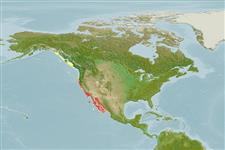
marino demersal; rango de profundidad 3 - 205 m (Ref. 9253), usually 3 - 46 m (Ref. 54903). Subtropical; 56°N - 4°S, 134°W - 77°W
Eastern Pacific: Canada to Gulf of California, south to northern Peru.
Longitud en la primera madurez / Tamaño / Peso / Edad
Madurez: Lm 97.0, range 86 - 108 cm
Max length : 152 cm TL macho / no sexado; (Ref. 247); edad máxima reportada: 35 años (Ref. 6147)
Descripción breve
Claves de identificación | Morfología | Morfometría
Espinas dorsales (total) : 0; Espinas anales: 0.
Body shape (shape guide): other.
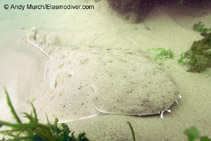
Found on the continental shelf and littoral areas (Ref. 247).A sluggish and inactive species that buries itself in sand or mud (Ref. 247). Also found around rocks, heads of submarine canyons, and sometimes near kelp forests (Ref. 247). Feeds on bottom and epibenthic fishes, including croakers, California halibut, and squid (Ref. 247). Ovoviviparous (Ref. 50449). Can whip up its head and snap very quickly when touched, provoked, harassed, or speared, and can inflict painful lacerations (Ref. 247).
Ciclo vital y comportamiento de apareamiento
Madurez | Reproducción | Puesta | Huevos | Fecundidad | Larva
Ovoviviparous, embryos feed solely on yolk (Ref. 50449).
Compagno, L.J.V., 1984. FAO Species Catalogue. Vol. 4. Sharks of the world. An annotated and illustrated catalogue of shark species known to date. Part 1 - Hexanchiformes to Lamniformes. FAO Fish. Synop. 125(4/1):1-249. Rome, FAO. (Ref. 247)
Situación en la Lista Roja de la UICN (Ref. 130435: Version 2025-2 (Global))
Amenaza para el ser humano
Usos humanos
Pesquerías: comercial
Herramientas
Informes especiales
Descargar XML
Fuentes de Internet
Estimaciones basadas en modelos
Temperatura preferida (Referencia
123201): 12.5 - 25.9, mean 21 °C (based on 60 cells).
Índice de diversidad filogenética (Referencia
82804): PD
50 = 0.5000 [Uniqueness, from 0.5 = low to 2.0 = high].
Bayesian length-weight: a=0.00661 (0.00287 - 0.01523), b=3.07 (2.88 - 3.26), in cm total length, based on LWR estimates for this Genus-body shape (Ref.
93245).
Nivel trófico (Referencia
69278): 4.1 ±0.4 se; based on diet studies.
Resiliencia (Referencia
120179): Muy bajo, población duplicada en un tiempo mínimo superior a 14 años (K=0.15-0.16; tm=8-13; tmax=35; Fec=6).
Vulnerabilidad pesquera (Ref.
59153): High to very high vulnerability (67 of 100).
🛈
Nutrientes (Ref.
124155): Calcium = 17.5 [3.6, 86.6] mg/100g; Iron = 0.795 [0.206, 2.275] mg/100g; Protein = 19.9 [17.8, 21.8] %; Omega3 = 0.363 [0.162, 0.801] g/100g; Selenium = 26.5 [7.5, 76.0] μg/100g; VitaminA = 9.99 [3.53, 27.74] μg/100g; Zinc = 0.421 [0.203, 0.760] mg/100g (wet weight);