Classificazione / Nomi
Nomi Comuni | Sinonimi | Catalog of Fishes(Genere, Specie) | ITIS | CoL | WoRMS | Cloffa
>
Myctophiformes (Lanternfishes) >
Myctophidae (Lanternfishes) > Diaphinae
Etymology: Diaphus: Greek, dis, dia = through + Greek, physa, phyo = to beget, to have as offspring (Ref. 45335); balanovi: Named for Dr. Andrei A. Balanov, A.V. Zhirmunsky National Scientific Center of Marine Biology, Far Eastern Branch of the Russian Academy of Sciences, Vladivostok.
Ambiente: milieu / zona climatica / distribuzione batimetrica / gamma di distribuzione
Ecologia
marino batipelagico; distribuzione batimetrica 642 - 1030 m (Ref. 125672). Deep-water
Northwest Pacific: Emperor Seamount Chain. High Seas only.
Dimensione / Peso / Età
Maturità: Lm ? range ? - ? cm
Max length : 9.6 cm SL maschio/sesso non determinato; (Ref. 125672)
Breve descrizione
Chiavi di identificazione | Morfologia | Morfometria
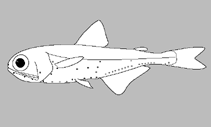
Raggi dorsali molli (totale) : 12 - 14; Raggi anali molli: 12 - 14. This species is distinguished from most of the Diaphus fulgens species complex members, except D. rafinesquii (North Atlantic and the Mediterranean Sea) and D. kuroshio (Kuroshio Zone in the North Pacific), by having a higher gill-raker count 24-28, almost always 25 or more (vs. 14–20). Similar to D. kuroshio in the disposition of photophores (VO5, SAO1, and SAO2 on the same line, AOa1 below level of SAO2, Prc4 its own diameter below lateral line), but differs to the latter by the large luminous scale at PLO, large
Dn, somewhat higher position of SAO3, otolith shape, and larger absolute size (at least 98 mm SL vs. about 70 mm). Otolith of Diaphus balanovi distinguished from the other species united in the Diaphus theta otolith group of Schwarzhans by the following characters: compressed shape with very weakly and uniformly convex outer face, rather steep and irregular predorsal rim, pronounced postdorsal angle, moderately long rostrum (18–19% of otolith length), and with 7-8 (usually eight) denticles along the ventral rim (Ref. 125672).
All specimens were collected by bottom trawls with non-closing openings and was quite abundant in catches, contrary to the single specimens of the mesopelagic D. kuroshio and D. metopoclampus in the same hauls, indicating that the new species can be associated with the seamounts and may have a benthopelagic mode of life. The larger absolute size in comparison with its closest relative and possible ancestor (D. kuroshio) supports this assumption (Ref. 125672).
Ciclo vitale e comportamento di accoppiamento
Maturità | Riproduzione | Deposizione | Uova | Fecondità | Larve
Prokofiev, A.M., O.R. Emelyanova, A.M. Orlov and S.Y. Orlova, 2022. A new species of Diaphus associated with seamounts of the Emperor Chain, North-Western Pacific Ocean (Teleostei: Myctophiformes: Myctophidae). J. Mar. Sci. Eng. 10(65):1-13. (Ref. 125672)
Stato della Lista Rossa IUCN (Ref. 130435: Version 2025-2 (Global))
Minaccia per l'uomo
Harmless
Usi umani
Pesca: di potenziale interesse
Strumenti
Rapporti speciali
Scarica XML
Fonti Internet
Stime basate su modelli
Indice di diversità filogenetica (Fonte Biblio.
82804): PD
50 = 0.5000 [Uniqueness, from 0.5 = low to 2.0 = high].
Bayesian length-weight: a=0.00794 (0.00349 - 0.01806), b=3.00 (2.81 - 3.19), in cm total length, based on LWR estimates for this Genus-body shape (Ref.
93245).
Livello trofico (Fonte Biblio.
69278): 3.1 ±0.3 se; based on size and trophs of closest relatives
Resilienza (Fonte Biblio.
120179): Alto, tempo minimo di raddoppiamento della popolazione meno di 15 mesi (Preliminary K or Fecundity.).
Vulnerabilità della pesca (Ref.
59153): Low vulnerability (10 of 100).
🛈