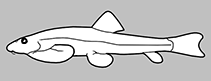
Classificação / Nomes
Nomes comuns | Sinônimos | Catalog of Fishes(Gênero, Espécies) | ITIS | CoL | WoRMS | Cloffa
>
Cypriniformes (Carps) >
Gastromyzontidae (Hillstream loaches)
Eponymy: Mari Albert Johan Van Manen (1877–1943) was a Dutch ethnographer, theosophist and orientalist who made a specialty of the study of Tibet and its texts. [...] (Ref. 128868), visit book page.
Meio ambiente: milieu / Zona climática / intervalo de profundidade / faixa de distribuição
Ecologia
; Água doce demersal. Subtropical
Asia: China.
Tamanho / Peso / Idade
Maturidade: Lm ? range ? - ? cm
Max length : 6.0 cm SL macho/indeterminado; (Ref. 120400)
Descrição suscinta
Chaves de identificação | Morfologia | Morfometria
This species is distinguished from its congeners in the barred group in Vanmanenia by the following set of characters: flank with 9-10 regular bars, widths approximately equal to the eye diameter (vs. 14-22 vermiculations with widths smaller than the eye diameter in V. microcephala); flank with 9-10 regular bars, widths approximately equal to the eye diameter (vs. 27-35 slim vermiculations with widths smaller than the eye diameter in V. serrilineata; vs. 4 large cloud-like blotches about 3-4 times the eye diameter and with a series of irregular dark cloud-like blotches on the flank in V. serrilineata); flank with 9-10 regular bars with widths approximately equal to the eye diameter (vs. 12-16 regular bars with widths equal to the eye diameter, and a paratype with 3 large cloud-like blotches about 3-4 times of eye diameter in V. crassicauda); flank with 9-10 regular bars with widths approximately equal to the eye diameter (vs. 16-21 vermiculations in V. striata); dorsal side of head covered by vermiculations (vs. a large dark blotch in V. crassicauda, V. microcephala, V. serrilineata); gill opening bigger with upper angle level to the middle point of the eye (vs. gill opening smaller with its upper angle level with the lower edge of the eye in V. microcephala); dorsal part of the body with 6-7 black saddles (vs. 4-5 in V. crassicauda, V. serrilineata); the blotch of the caudal-fin base complete and connected to the upper and lower margins of the caudal peduncle (vs. dissociated, not connected to the upper and lower margins of the caudal peduncle in V. microcephala, V. striata); anus located between the pelvic-fin insertion and anal-fin origin (vs. anus in front one third between the pelvic-fin insertion and anal-fin origin in V. microcephala, V. striata, V. tetraloba); rostral fold divided into three lobes with a smooth and arcuate outer edge and possesses inner and outer rostral barbels (Ref. 120400).
Cross section: circular.
Ciclo de vida ou comportamento de acasalamento
Maturidade | Reprodução | Desova | Ovos | Fecundidade | Larvas
Li, X., W. Zhou and X.-J. Che, 2019. Loaches of Vanmanenia (Cypriniformes: Gastromyzontidae) from Yunnan, China with description of a new species. Zootaxa 4603(1):125-144. (Ref. 120400)
Status na Lista Vermelha da UICN (Ref. 130435: Version 2025-2 (Global))
Ameaça para os humanos
Harmless
Uso pelos humanos
Ferramentas
Relatórios especiais
Baixar XML
Fontes da internet
Estimativas baseadas em modelos
Índice de diversidade filogenética (Ref.
82804): PD
50 = 0.5000 [Uniqueness, from 0.5 = low to 2.0 = high].
Bayesian length-weight: a=0.00646 (0.00285 - 0.01461), b=3.11 (2.91 - 3.31), in cm total length, based on LWR estimates for this (Sub)family-body shape (Ref.
93245).
Nível Trófico (Ref.
69278): 2.7 ±0.2 se; based on size and trophs of closest relatives
Vulnerabilidade da pesca (Ref.
59153): Low vulnerability (10 of 100).
🛈