Classificatie / Namen
Lokale namen | Synoniemen | Catalog of Fishes(Genus, Soort(en)) | ITIS | CoL | WoRMS | Cloffa
>
Cypriniformes (Carps) >
Gastromyzontidae (Hillstream loaches)
Eponymy: Mari Albert Johan Van Manen (1877–1943) was a Dutch ethnographer, theosophist and orientalist who made a specialty of the study of Tibet and its texts. [...] (Ref. 128868), visit book page.
Milieu: milieu / Klimaatzone / Diepte / verspreidingsgebied
Ecologie
; zoet water demersaal. Subtropical
Asia: China.
Grootte / Gewicht / Leeftijd
Maturiteit: Lm ? range ? - ? cm
Max length : 6.0 cm SL mannelijk / geslacht onbekend; (Ref. 120400)
Korte beschrijving
Determinatiesleutels | Morfologie | Morfometrie
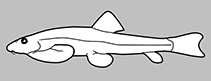
This species is distinguished from its congeners in the barred group in Vanmanenia by the following set of characters: flank with 9-10 regular bars, widths approximately equal to the eye diameter (vs. 14-22 vermiculations with widths smaller than the eye diameter in V. microcephala); flank with 9-10 regular bars, widths approximately equal to the eye diameter (vs. 27-35 slim vermiculations with widths smaller than the eye diameter in V. serrilineata; vs. 4 large cloud-like blotches about 3-4 times the eye diameter and with a series of irregular dark cloud-like blotches on the flank in V. serrilineata); flank with 9-10 regular bars with widths approximately equal to the eye diameter (vs. 12-16 regular bars with widths equal to the eye diameter, and a paratype with 3 large cloud-like blotches about 3-4 times of eye diameter in V. crassicauda); flank with 9-10 regular bars with widths approximately equal to the eye diameter (vs. 16-21 vermiculations in V. striata); dorsal side of head covered by vermiculations (vs. a large dark blotch in V. crassicauda, V. microcephala, V. serrilineata); gill opening bigger with upper angle level to the middle point of the eye (vs. gill opening smaller with its upper angle level with the lower edge of the eye in V. microcephala); dorsal part of the body with 6-7 black saddles (vs. 4-5 in V. crassicauda, V. serrilineata); the blotch of the caudal-fin base complete and connected to the upper and lower margins of the caudal peduncle (vs. dissociated, not connected to the upper and lower margins of the caudal peduncle in V. microcephala, V. striata); anus located between the pelvic-fin insertion and anal-fin origin (vs. anus in front one third between the pelvic-fin insertion and anal-fin origin in V. microcephala, V. striata, V. tetraloba); rostral fold divided into three lobes with a smooth and arcuate outer edge and possesses inner and outer rostral barbels (Ref. 120400).
Cross section: circular.
Levenscyclus en paargedrag
Maturiteit | Voortplanting | Paaien | Eieren | Fecunditeit | Larven
Li, X., W. Zhou and X.-J. Che, 2019. Loaches of Vanmanenia (Cypriniformes: Gastromyzontidae) from Yunnan, China with description of a new species. Zootaxa 4603(1):125-144. (Ref. 120400)
Status op de Rode Lijst van het IUCN (Ref. 130435: Version 2025-2 (Global))
Gevaar voor de mens
Harmless
Gebruik door de mens
Tools
Speciale rapporten
Download XML
Internetbronnen
Schattingen op basis van modellen
Fylogenetische diversiteitsindex (Ref.
82804): PD
50 = 0.5000 [Uniqueness, from 0.5 = low to 2.0 = high].
Bayesian length-weight: a=0.00646 (0.00285 - 0.01461), b=3.11 (2.91 - 3.31), in cm total length, based on LWR estimates for this (Sub)family-body shape (Ref.
93245).
Trofisch niveau (Ref.
69278): 2.7 ±0.2 se; based on size and trophs of closest relatives
Kwetsbaarheid van de visserij (Ref.
59153): Low vulnerability (10 of 100).
🛈