>
Blenniiformes (Blennies) >
Tripterygiidae (Triplefin blennies) > Tripterygiinae
Etymology: Enneapterygius: Greek, ennea = nine times + Greek, pterygion = little fin (Ref. 45335); phoenicosoma: Name from Greek 'phoenico' for red and 'soma' for body, referring to the red body of nuptial males; noun in apposition.
Môi trường: môi trường / vùng khí hậu / Mức độ sâu / phạm vi phân phối
Sinh thái học
biển cùng sống ở rạn san hô; mức độ sâu ? - 25 m (Ref. 118055), usually ? - 15 m (Ref. 118055). Subtropical
Western Pacific: Japan, Caroline Is., and Vanuatu.
Bộ gần gũi / Khối lượng (Trọng lượng) / Tuổi
Chín muồi sinh dục: Lm ? range ? - ? cm
Max length : 3.7 cm SL con đực/không giới tính; (Ref. 118055)
Mô tả ngắn gọn
Khóa để định loại | Hình thái học | Sinh trắc học
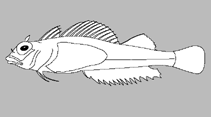
Các tia vây lưng cứng (tổng cộng) : 14 - 16; Các vây lưng mềm (tổng cộng) : 8 - 10; Tia cứng vây hậu môn: 1; Tia mềm vây hậu môn: 16 - 18. This species is distinguished by the following set of characters: second dorsal-fin spines 11-13 (mode 12) ; third dorsal-fin soft rays 8-10 (9); pectoral-fin rays 15-17 (16); anal-fin soft rays 16-18 (17); scale rows in longitudinal series 32-35 (33); pored lateral-line scales 16-19 (17); notched lateral-line scales 16-19 (18); scale row between last pored lateral-line scale and first notched lateral-line scale 1; mandibular pore formula 4-6+1+4-6 (4+1+4); dorsal-fin spines and rays long [e.g., lengths of second spine 8.6-12.6% of SL (mean 10.1%) and third spine 7.2-9.8% of SL (8.5%) in first dorsal fin; first spine 12.8-17.2% of SL (15.2%), second spine 13.8-18.2% of SL (15.9%), and third spine 14.2-18.4% of SL (15.8%) in second dorsal fin; and first soft ray 14.8-19.5% of SL (17.3%), second soft ray 14.7-18.9% of SL (16.9%), and third soft ray 13.9-19.1% of SL (15.9%) in third dorsal fin]; second dorsal-fin base short [25.0-32.9% of SL (mean 29.2%)]; anal-fin base short [36.9-43.5% of SL (mean 40.5%)]; the nasal tentacle unbranched, flat, broadened distally; lower two-thirds of head, including lower half of eye, snout, lips, cheek, and opercle, and pectoral-fin base, dense black in nuptial males; upper head and body is reddish-brown in males and females, reddish in nuptial males, with H-shaped and/or upside-down Y-shaped oblique brown bars on lateral surface of body in both sexes; the caudal-fin base with vertical brownish band, its width subequal to pupil diameter, and narrow vertical white band behind brownish band in both sexes; narrow, indistinct, white line along posterior margin of black area on pectoral-fin base in nuptial males; pectoral, pelvic, and anal fins reddish in nuptial males; no black fins (Ref. 118055).
Cross section: oval.
This species is usually found in open tide-pools and areas with strong regular surges generated by wave swells. Individuals often inhabit the surface of large rocks, but also slits and holes in large rocks, at depths of less than 25 m (usually less than 15 m). Spawning at Shikoku is reported to occur from early morning until about 10 am starting in June (Ref. 118055).
Vòng đời và hành vi giao phối
Chín muồi sinh dục | Sự tái sinh sản | Đẻ trứng | Các trứng | Sự sinh sản | Ấu trùng
Motomura, H., R. Ota, M. Meguro and S. Tashiro, 2015. Enneapterygius phoenicosoma, a new species of triplefin (Tripterygiidae) from the Western Pacific Ocean. Species Diversity 20:1-12. (Ref. 118055)
Tình trạng Sách đỏ IUCN (Ref. 130435: Version 2025-2 (Global))
Mối đe dọa đối với con người
Harmless
Sử dụng của con người
Các nghề cá: không ích lợi (thú vị)
Các công cụ
Báo cáo đặc biệt
Tải xuống XML
Các nguồn internet
Ước tính dựa trên mô hình
Chỉ số đa dạng phát sinh loài (Tài liệu tham khảo
82804): PD
50 = 0.5000 [Uniqueness, from 0.5 = low to 2.0 = high].
Bayesian length-weight: a=0.00617 (0.00290 - 0.01310), b=3.04 (2.86 - 3.22), in cm total length, based on LWR estimates for this (Sub)family-body shape (Ref.
93245).
Mức dinh dưỡng (Tài liệu tham khảo
69278): 3.2 ±0.3 se; based on size and trophs of closest relatives
Thích nghi nhanh (Tài liệu tham khảo
120179): Chiêù cao, thời gian nhân đôi của chủng quần tối thiểu là dưới 15 tháng (Preliminary K or Fecundity.).
Sự dễ bị tổn thương của nghề đánh cá (Ref.
59153): Low vulnerability (10 of 100).
🛈