分类 / 名称
俗名 | 同种异名 | Catalog of Fishes(属, 种) | ITIS | CoL | WoRMS | Cloffa
Teleostei >
Blenniiformes (Blennies) >
Tripterygiidae (Triplefin blennies) > Tripterygiinae
Etymology: Enneapterygius: Greek, ennea = nine times + Greek, pterygion = little fin (Ref. 45335); phoenicosoma: Name from Greek 'phoenico' for red and 'soma' for body, referring to the red body of nuptial males; noun in apposition.
环境:氛围 / 气候带 / 深度上下限 / 分布范围
生态学
海洋 礁区鱼类; 深度上下限 ? - 25 m (Ref. 118055), usually ? - 15 m (Ref. 118055).
分布
领土 | FAO区域 | 生态系 | 标本纪录 | 分布图 | 简介 | Faunafri
Western Pacific: Japan, Caroline Is., and Vanuatu.
大小 / 重量 / 年龄
成熟度: Lm ? range ? - ? cm
Max length : 3.7 cm SL 雄鱼/尚未辨别雌雄; (Ref. 118055)
简单描述
检索表 | 型态特徵 | 形态测量图
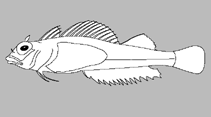
背棘 (总数) : 14 - 16; 背的软条 (总数) : 8 - 10; 臀棘: 1; 臀鳍软条: 16 - 18. This species is distinguished by the following set of characters: second dorsal-fin spines 11-13 (mode 12) ; third dorsal-fin soft rays 8-10 (9); pectoral-fin rays 15-17 (16); anal-fin soft rays 16-18 (17); scale rows in longitudinal series 32-35 (33); pored lateral-line scales 16-19 (17); notched lateral-line scales 16-19 (18); scale row between last pored lateral-line scale and first notched lateral-line scale 1; mandibular pore formula 4-6+1+4-6 (4+1+4); dorsal-fin spines and rays long [e.g., lengths of second spine 8.6-12.6% of SL (mean 10.1%) and third spine 7.2-9.8% of SL (8.5%) in first dorsal fin; first spine 12.8-17.2% of SL (15.2%), second spine 13.8-18.2% of SL (15.9%), and third spine 14.2-18.4% of SL (15.8%) in second dorsal fin; and first soft ray 14.8-19.5% of SL (17.3%), second soft ray 14.7-18.9% of SL (16.9%), and third soft ray 13.9-19.1% of SL (15.9%) in third dorsal fin]; second dorsal-fin base short [25.0-32.9% of SL (mean 29.2%)]; anal-fin base short [36.9-43.5% of SL (mean 40.5%)]; the nasal tentacle unbranched, flat, broadened distally; lower two-thirds of head, including lower half of eye, snout, lips, cheek, and opercle, and pectoral-fin base, dense black in nuptial males; upper head and body is reddish-brown in males and females, reddish in nuptial males, with H-shaped and/or upside-down Y-shaped oblique brown bars on lateral surface of body in both sexes; the caudal-fin base with vertical brownish band, its width subequal to pupil diameter, and narrow vertical white band behind brownish band in both sexes; narrow, indistinct, white line along posterior margin of black area on pectoral-fin base in nuptial males; pectoral, pelvic, and anal fins reddish in nuptial males; no black fins (Ref. 118055).
Cross section: oval.
This species is usually found in open tide-pools and areas with strong regular surges generated by wave swells. Individuals often inhabit the surface of large rocks, but also slits and holes in large rocks, at depths of less than 25 m (usually less than 15 m). Spawning at Shikoku is reported to occur from early morning until about 10 am starting in June (Ref. 118055).
生命周期和交配行为
成熟度 | 繁殖 | 产卵场 | 卵 | 孕卵数 | 仔鱼
Motomura, H., R. Ota, M. Meguro and S. Tashiro, 2015. Enneapterygius phoenicosoma, a new species of triplefin (Tripterygiidae) from the Western Pacific Ocean. Species Diversity 20:1-12. (Ref. 118055)
世界自然保护联盟红皮书 (Ref. 130435: Version 2025-2 (Global))
人类利用
渔业: 没有兴趣
工具
特别资料
下载 XML
网络资源
基于模型的估算
系统发育多样性指数 (参考文献
82804): PD
50 = 0.5000 [Uniqueness, from 0.5 = low to 2.0 = high].
Bayesian length-weight: a=0.00617 (0.00290 - 0.01310), b=3.04 (2.86 - 3.22), in cm total length, based on LWR estimates for this (Sub)family-body shape (Ref.
93245).
营养阶层 (参考文献
69278): 3.2 ±0.3 se; based on size and trophs of closest relatives
回复力 (参考文献
120179): 高度, 族群倍增时间少于 15个月 (Preliminary K or Fecundity.).
渔业脆弱性 (Ref.
59153): Low vulnerability (10 of 100).
🛈