>
Blenniiformes (Blennies) >
Tripterygiidae (Triplefin blennies) > Tripterygiinae
Etymology: Enneapterygius: Greek, ennea = nine times + Greek, pterygion = little fin (Ref. 45335); phoenicosoma: Name from Greek 'phoenico' for red and 'soma' for body, referring to the red body of nuptial males; noun in apposition.
Ambiente: milieu / zona climatica / distribuzione batimetrica / gamma di distribuzione
Ecologia
marino associati a barriera corallina; distribuzione batimetrica ? - 25 m (Ref. 118055), usually ? - 15 m (Ref. 118055). Subtropical
Western Pacific: Japan, Caroline Is., and Vanuatu.
Dimensione / Peso / Età
Maturità: Lm ? range ? - ? cm
Max length : 3.7 cm SL maschio/sesso non determinato; (Ref. 118055)
Breve descrizione
Chiavi di identificazione | Morfologia | Morfometria
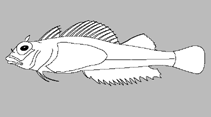
Spine dorsali (totale) : 14 - 16; Raggi dorsali molli (totale) : 8 - 10; Spine anali: 1; Raggi anali molli: 16 - 18. This species is distinguished by the following set of characters: second dorsal-fin spines 11-13 (mode 12) ; third dorsal-fin soft rays 8-10 (9); pectoral-fin rays 15-17 (16); anal-fin soft rays 16-18 (17); scale rows in longitudinal series 32-35 (33); pored lateral-line scales 16-19 (17); notched lateral-line scales 16-19 (18); scale row between last pored lateral-line scale and first notched lateral-line scale 1; mandibular pore formula 4-6+1+4-6 (4+1+4); dorsal-fin spines and rays long [e.g., lengths of second spine 8.6-12.6% of SL (mean 10.1%) and third spine 7.2-9.8% of SL (8.5%) in first dorsal fin; first spine 12.8-17.2% of SL (15.2%), second spine 13.8-18.2% of SL (15.9%), and third spine 14.2-18.4% of SL (15.8%) in second dorsal fin; and first soft ray 14.8-19.5% of SL (17.3%), second soft ray 14.7-18.9% of SL (16.9%), and third soft ray 13.9-19.1% of SL (15.9%) in third dorsal fin]; second dorsal-fin base short [25.0-32.9% of SL (mean 29.2%)]; anal-fin base short [36.9-43.5% of SL (mean 40.5%)]; the nasal tentacle unbranched, flat, broadened distally; lower two-thirds of head, including lower half of eye, snout, lips, cheek, and opercle, and pectoral-fin base, dense black in nuptial males; upper head and body is reddish-brown in males and females, reddish in nuptial males, with H-shaped and/or upside-down Y-shaped oblique brown bars on lateral surface of body in both sexes; the caudal-fin base with vertical brownish band, its width subequal to pupil diameter, and narrow vertical white band behind brownish band in both sexes; narrow, indistinct, white line along posterior margin of black area on pectoral-fin base in nuptial males; pectoral, pelvic, and anal fins reddish in nuptial males; no black fins (Ref. 118055).
Cross section: oval.
This species is usually found in open tide-pools and areas with strong regular surges generated by wave swells. Individuals often inhabit the surface of large rocks, but also slits and holes in large rocks, at depths of less than 25 m (usually less than 15 m). Spawning at Shikoku is reported to occur from early morning until about 10 am starting in June (Ref. 118055).
Ciclo vitale e comportamento di accoppiamento
Maturità | Riproduzione | Deposizione | Uova | Fecondità | Larve
Motomura, H., R. Ota, M. Meguro and S. Tashiro, 2015. Enneapterygius phoenicosoma, a new species of triplefin (Tripterygiidae) from the Western Pacific Ocean. Species Diversity 20:1-12. (Ref. 118055)
Stato della Lista Rossa IUCN (Ref. 130435: Version 2025-2 (Global))
Minaccia per l'uomo
Harmless
Usi umani
Pesca: di nessun interesse
Strumenti
Rapporti speciali
Scarica XML
Fonti Internet
Stime basate su modelli
Indice di diversità filogenetica (Fonte Biblio.
82804): PD
50 = 0.5000 [Uniqueness, from 0.5 = low to 2.0 = high].
Bayesian length-weight: a=0.00617 (0.00290 - 0.01310), b=3.04 (2.86 - 3.22), in cm total length, based on LWR estimates for this (Sub)family-body shape (Ref.
93245).
Livello trofico (Fonte Biblio.
69278): 3.2 ±0.3 se; based on size and trophs of closest relatives
Resilienza (Fonte Biblio.
120179): Alto, tempo minimo di raddoppiamento della popolazione meno di 15 mesi (Preliminary K or Fecundity.).
Vulnerabilità della pesca (Ref.
59153): Low vulnerability (10 of 100).
🛈