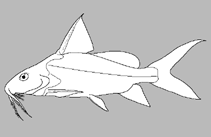
Классификация / Имена
народные названия | синонимы | Catalog of Fishes(род, виды) | ITIS | CoL | WoRMS | Cloffa
>
Siluriformes (Catfishes) >
Mochokidae (Squeakers or upside-down catfishes) > Chiloglanidinae
Etymology: Chiloglanis: Greek, cheilos = lip + Greek, glanis = a fish that can eat the bait without touching the hook; a cat fish (Ref. 45335); dialloi: This species is named for Guinean fisheries biologist, Samba Diallo, who provided logistical support and assisted in the field during the 2003 and 2013 expeditions; his efforts are largely responsible for the success of the expeditions and the subsequent descriptions of different new species (Ref. 116018).
Eponymy: Samba Diallo is a Guinean fisheries biologist who is (2002) Director of the National Center for Fisheries Science of Boussoura, Guinea. [...] (Ref. 128868), visit book page.
Окружающая среда: среда / климатическая зона / пределы глубины / диапазон распространения
экология
; пресноводный донно-пелагический. Tropical
Africa: Moa River drainage in Guinea and possibly in Sierra Leone (Ref. 116018).
Размер / Вес / Возраст
половая зрелость: Lm ? range ? - ? cm
Max length : 5.2 cm SL самец/пол неопределен; (Ref. 116018)
Краткое описание
определительные ключи | морфология | морфометрия
колючие лучи спинного плавника (общее число) : 2; членистые (мягкие) лучи спинного плавника (общее число) : 5 - 6; колючие лучи анального плавника: 0; членистые (мягкие) лучи анального плавника: 9. Diagnosis: Chiloglanis dialloi is distinguished from C. normani, C. waterloti, C. longibarbis, C. occidentalis, C. kabaensis, C. kolente, and C. nzerekore in possessing more mandibular teeth in the functional row, and readily distinguished from C. polyodon and C. lamottei in having fewer mandibular teeth in the functional row; it can be distinguished from Chiloglanis aff. micropogon in possessing moderately long mandibular barbels vs. reduced or absent mandibular barbels; it is distinguished from C. tweddlei and C. pezoldi in having shorter pectoral and dorsal spines; it is distinguished from C. camarabounyi in having a shallower body depth at anus, 12.0-14.5% of standard length vs. 14.8-18.2%, and at the dorsal-fin origin, 15.3-17.7% of standard length vs. 16.3-22.5%, and a shorter dorsal spine; it can be distinguished from C. loffabrevum in having a smaller premaxillary tooth pad width, 15.1-16.6% of standard length vs. 16.9-20.2%, and length, 2.9-3.7% of standard length vs. 3.4-5.4%, a narrower anterior nare interspace, 4.1-4.3% of standard length vs. 4.5-6.3%, and a shorter pre-pectoral length, 29.0-32.6% of standard length vs. 31.9-37.1% (Ref. 116018).
Body shape (shape guide): elongated.
Жизненный цикл и брачное поведение
половая зрелость | размножение | нерест | икра | Плодовитость | личинки
Schmidt, R.C., H.L. Bart, F. Pezold and J.P. Friel, 2017. A biodiversity hotspot heats up: Nine new species of suckermouth catfishes (Mochokidae: Chiloglanis) from Upper Guinean forest steams in West Africa. Copeia 105(2):301-338. (Ref. 116018)
Статус Красного Списка МСОП (Ref. 130435: Version 2025-2 (Global))
Угроза для людей
Harmless
Использование человеком
рыболовство: интереса не представляет
дополнительная информация
инструменты
Специальные отчеты
Скачать в формате XML
ресурсы в Интернет
Оценки, основанные на моделях
Индекс филогенетического разнообразия (ссылка
82804): PD
50 = 0.5000 [Uniqueness, from 0.5 = low to 2.0 = high].
Bayesian length-weight: a=0.00389 (0.00180 - 0.00842), b=3.12 (2.94 - 3.30), in cm total length, based on all LWR estimates for this body shape (Ref.
93245).
Трофический уровень (ссылка
69278): 3.2 ±0.4 se; based on size and trophs of closest relatives
устойчивость к внешним воздействиям (ссылка
120179): высокий, минимальное время удвоения популяции до 15 месяцев (Preliminary K or Fecundity.).
Уязвимость рыбной ловли (Ref.
59153): Low vulnerability (10 of 100).
🛈