Classificação / Nomes
Nomes comuns | Sinónimos | Catalog of Fishes(Género, Espécies) | ITIS | CoL | WoRMS | Cloffa
>
Siluriformes (Catfishes) >
Mochokidae (Squeakers or upside-down catfishes) > Chiloglanidinae
Etymology: Chiloglanis: Greek, cheilos = lip + Greek, glanis = a fish that can eat the bait without touching the hook; a cat fish (Ref. 45335); dialloi: This species is named for Guinean fisheries biologist, Samba Diallo, who provided logistical support and assisted in the field during the 2003 and 2013 expeditions; his efforts are largely responsible for the success of the expeditions and the subsequent descriptions of different new species (Ref. 116018).
Eponymy: Samba Diallo is a Guinean fisheries biologist who is (2002) Director of the National Center for Fisheries Science of Boussoura, Guinea. [...] (Ref. 128868), visit book page.
Ambiente: milieu / zona climática / intervalo de profundidade / gama de distribuição
Ecologia
; Água doce bentopelágico. Tropical
Africa: Moa River drainage in Guinea and possibly in Sierra Leone (Ref. 116018).
Tamanho / Peso / Idade
Maturidade: Lm ? range ? - ? cm
Max length : 5.2 cm SL macho/indeterminado; (Ref. 116018)
Descrição breve
Chaves de identificação | Morfologia | Morfometria
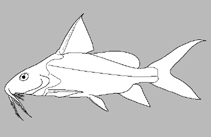
Espinhos dorsais (total) : 2; Raios dorsais moles (total) : 5 - 6; Espinhos anais: 0; Raios anais moles: 9. Diagnosis: Chiloglanis dialloi is distinguished from C. normani, C. waterloti, C. longibarbis, C. occidentalis, C. kabaensis, C. kolente, and C. nzerekore in possessing more mandibular teeth in the functional row, and readily distinguished from C. polyodon and C. lamottei in having fewer mandibular teeth in the functional row; it can be distinguished from Chiloglanis aff. micropogon in possessing moderately long mandibular barbels vs. reduced or absent mandibular barbels; it is distinguished from C. tweddlei and C. pezoldi in having shorter pectoral and dorsal spines; it is distinguished from C. camarabounyi in having a shallower body depth at anus, 12.0-14.5% of standard length vs. 14.8-18.2%, and at the dorsal-fin origin, 15.3-17.7% of standard length vs. 16.3-22.5%, and a shorter dorsal spine; it can be distinguished from C. loffabrevum in having a smaller premaxillary tooth pad width, 15.1-16.6% of standard length vs. 16.9-20.2%, and length, 2.9-3.7% of standard length vs. 3.4-5.4%, a narrower anterior nare interspace, 4.1-4.3% of standard length vs. 4.5-6.3%, and a shorter pre-pectoral length, 29.0-32.6% of standard length vs. 31.9-37.1% (Ref. 116018).
Body shape (shape guide): elongated.
Ciclo de vida e comportamento de acasalamento
Maturidade | Reprodução | Desova | Ovos | Fecundidade | Larvas
Schmidt, R.C., H.L. Bart, F. Pezold and J.P. Friel, 2017. A biodiversity hotspot heats up: Nine new species of suckermouth catfishes (Mochokidae: Chiloglanis) from Upper Guinean forest steams in West Africa. Copeia 105(2):301-338. (Ref. 116018)
Categoria na Lista Vermelha da IUCN (Ref. 130435: Version 2025-2 (Global))
Ameaça para o homem
Harmless
Utilização humana
Pescarias: sem interesse
Ferramentas
Relatórios especiais
Descarregue XML
Fontes da internet
Estimativas baseadas em modelos
Índice de diversidade filogenética (Ref.
82804): PD
50 = 0.5000 [Uniqueness, from 0.5 = low to 2.0 = high].
Bayesian length-weight: a=0.00389 (0.00180 - 0.00842), b=3.12 (2.94 - 3.30), in cm total length, based on all LWR estimates for this body shape (Ref.
93245).
Nível Trófico (Ref.
69278): 3.2 ±0.4 se; based on size and trophs of closest relatives
Resiliência (Ref.
120179): Elevada, tempo mínimo de duplicação da população menor que 15 meses (Preliminary K or Fecundity.).
Vulnerabilidade da pesca (Ref.
59153): Low vulnerability (10 of 100).
🛈