klasifikasi / Nama
Nama-nama umum | Sinonim (persamaan) | Catalog of Fishes(Marga, Jenis) | ITIS | CoL | WoRMS | Cloffa
>
Siluriformes (Catfishes) >
Mochokidae (Squeakers or upside-down catfishes) > Chiloglanidinae
Etymology: Chiloglanis: Greek, cheilos = lip + Greek, glanis = a fish that can eat the bait without touching the hook; a cat fish (Ref. 45335); dialloi: This species is named for Guinean fisheries biologist, Samba Diallo, who provided logistical support and assisted in the field during the 2003 and 2013 expeditions; his efforts are largely responsible for the success of the expeditions and the subsequent descriptions of different new species (Ref. 116018).
Eponymy: Samba Diallo is a Guinean fisheries biologist who is (2002) Director of the National Center for Fisheries Science of Boussoura, Guinea. [...] (Ref. 128868), visit book page.
Lingkungan: lingkungan / zona iklim / kisaran kedalaman / jangkauan distribusi
Ekologi
; air tawar bentopelagis. Tropical
Africa: Moa River drainage in Guinea and possibly in Sierra Leone (Ref. 116018).
Ukuran / Berat / umur
Kematangan: Lm ? range ? - ? cm
Max length : 5.2 cm SL jantan/; (Ref. 116018)
deskripsi pendek
Kunci identifiaksi (pengenalan) | Morfologi | Morfometrik
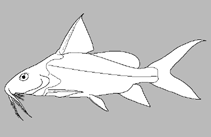
Duri punggung (Keseluruhan (total)) : 2; duri punggung lunak (Keseluruhan (total)) : 5 - 6; Duri dubur: 0; Sirip dubur lunak: 9. Diagnosis: Chiloglanis dialloi is distinguished from C. normani, C. waterloti, C. longibarbis, C. occidentalis, C. kabaensis, C. kolente, and C. nzerekore in possessing more mandibular teeth in the functional row, and readily distinguished from C. polyodon and C. lamottei in having fewer mandibular teeth in the functional row; it can be distinguished from Chiloglanis aff. micropogon in possessing moderately long mandibular barbels vs. reduced or absent mandibular barbels; it is distinguished from C. tweddlei and C. pezoldi in having shorter pectoral and dorsal spines; it is distinguished from C. camarabounyi in having a shallower body depth at anus, 12.0-14.5% of standard length vs. 14.8-18.2%, and at the dorsal-fin origin, 15.3-17.7% of standard length vs. 16.3-22.5%, and a shorter dorsal spine; it can be distinguished from C. loffabrevum in having a smaller premaxillary tooth pad width, 15.1-16.6% of standard length vs. 16.9-20.2%, and length, 2.9-3.7% of standard length vs. 3.4-5.4%, a narrower anterior nare interspace, 4.1-4.3% of standard length vs. 4.5-6.3%, and a shorter pre-pectoral length, 29.0-32.6% of standard length vs. 31.9-37.1% (Ref. 116018).
Body shape (shape guide): elongated.
Siklus hidup dan perilaku kawin
Kematangan | Reproduksi, perkembang biakan | Pemijahan | telur-telur | Fekunditas | Larva
Schmidt, R.C., H.L. Bart, F. Pezold and J.P. Friel, 2017. A biodiversity hotspot heats up: Nine new species of suckermouth catfishes (Mochokidae: Chiloglanis) from Upper Guinean forest steams in West Africa. Copeia 105(2):301-338. (Ref. 116018)
Status IUCN Red List (Ref. 130435: Version 2025-2 (Global))
ancaman kepada manusia
Harmless
penggunaan manusia
Perikanan: tidak ada kepentingan
Alat, peralatan
laporan khas
muat turun XML
Sumber internet
Estimasi berdasarkan model
Indeks keanekaragaman filogenetik (Acuan
82804): PD
50 = 0.5000 [Uniqueness, from 0.5 = low to 2.0 = high].
Bayesian length-weight: a=0.00389 (0.00180 - 0.00842), b=3.12 (2.94 - 3.30), in cm total length, based on all LWR estimates for this body shape (Ref.
93245).
Tingkat Trofik (Acuan
69278): 3.2 ±0.4 se; based on size and trophs of closest relatives
Daya lenting (Acuan
120179): Tinggi, Waktu penggandaan populasi minimum kurang dari 15 bulan (Preliminary K or Fecundity.).
Kerentanan Penangkapan Ikan (Ref.
59153): Low vulnerability (10 of 100).
🛈