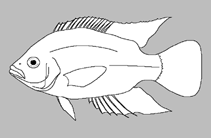
Clasificación / Nombres
Nombres comunes | Sinónimos | Catalog of Fishes(Género, Especie) | ITIS | CoL | WoRMS | Cloffa
>
Cichliformes (Cichlids, convict blennies) >
Cichlidae (Cichlids) > Pseudocrenilabrinae
Etymology: Hemitaeniochromis: Greek, hemi = half + Latin, taenia, -ae = strip + Greek, chromis = a fish, perhaps a perch (Ref. 45335); brachyrhynchus: Latinized from the Greek adjective βραχύσ, short, and noun ρύγχοσ, snout, in reference to the abbreviated preocular region of the head; brachyrhynchus is a noun in apposition (Ref. 91204).
Entorno: milieu / zona climática / rango de profundidad / gama de distribución
Ecología
; agua dulce pelágico. Tropical
Africa: Lake Malawi (Ref. 91204).
Tamaño / Peso / Edad
Madurez: Lm ? range ? - ? cm
Max length : 124 cm SL macho / no sexado; (Ref. 91204)
Descripción breve
Claves de identificación | Morfología | Morfometría
Espinas dorsales (total) : 17; Radios blandos dorsales (total) : 10; Espinas anales: 3; Radios blandos anales: 9. Diagnosis: Hemitaeniochromis brachyrhynchus is readily distinguished from its formal congener H. urotaenia, by its narrow lacrimal bone whose width, at the midpoint of the bone, is one-third of the orbit length, vs. nearly equal to the orbit length in H. urotaenia; by its snout being shorter than the orbit length, vs. longer in H. urotaenia; by its much larger eyes, the orbit length being about 36-38% of head length, vs. 22-28% in H. urotaenia; by its shorter lower jaw which is about 39-41% of head length, vs. 45-51% in H. urotaenia; and by its melanin pattern, which is composed of spots and line segments that are less well-defined than those of H. urotaenia (Ref. 91204). The narrow lacrimal and large eyes also distinguish H. brachyrhynchus from all other species that have sometimes been placed in Hemitaeniochromis (Ref. 91204).
Body shape (shape guide): fusiform / normal.
The distinctive lower-jaw teeth, with their outwardly and anteriorly angled crowns are similar to those of other haplochromine cichlids that have a paedophagous diet (Ref. 91204). The conservation status is unknown; it may normally inhabit deeper water than has generally been sampled over rocky substrates; and the widely separated localities of the two type specimens at least demonstrate that the species is not restricted to a single circumscribed area (Ref. 91204).
Ciclo vital y comportamiento de apareamiento
Madurez | Reproducción | Puesta | Huevos | Fecundidad | Larva
Oliver, M.K., 2012. Hemitaenichromis brachyrhynchus, a new species of cichlid fish from Lake Malaŵi, with comments on some other supposed members of the genus (Teleostei: Cichlidae). Zootaxa 3410:35-50. (Ref. 91204)
Situación en la Lista Roja de la UICN (Ref. 130435: Version 2025-2 (Global))
Amenaza para el ser humano
Harmless
Usos humanos
Pesquerías: sin interés
Herramientas
Informes especiales
Descargar XML
Fuentes de Internet
Estimaciones basadas en modelos
Índice de diversidad filogenética (Referencia
82804): PD
50 = 0.7500 [Uniqueness, from 0.5 = low to 2.0 = high].
Bayesian length-weight: a=0.00389 (0.00180 - 0.00842), b=3.12 (2.94 - 3.30), in cm total length, based on all LWR estimates for this body shape (Ref.
93245).
Nivel trófico (Referencia
69278): 3.8 ±0.5 se; based on size and trophs of closest relatives
Resiliencia (Referencia
120179): Muy bajo, población duplicada en un tiempo mínimo superior a 14 años (Preliminary K or Fecundity.).
Vulnerabilidad pesquera (Ref.
59153): Very high vulnerability (90 of 100).
🛈