Classificazione / Nomi
Nomi Comuni | Sinonimi | Catalog of Fishes(Genere, Specie) | ITIS | CoL | WoRMS | Cloffa
>
Cichliformes (Cichlids, convict blennies) >
Cichlidae (Cichlids) > Pseudocrenilabrinae
Etymology: Hemitaeniochromis: Greek, hemi = half + Latin, taenia, -ae = strip + Greek, chromis = a fish, perhaps a perch (Ref. 45335); brachyrhynchus: Latinized from the Greek adjective βραχύσ, short, and noun ρύγχοσ, snout, in reference to the abbreviated preocular region of the head; brachyrhynchus is a noun in apposition (Ref. 91204).
Ambiente: milieu / zona climatica / distribuzione batimetrica / gamma di distribuzione
Ecologia
; acqua dolce pelagico. Tropical
Africa: Lake Malawi (Ref. 91204).
Dimensione / Peso / Età
Maturità: Lm ? range ? - ? cm
Max length : 124 cm SL maschio/sesso non determinato; (Ref. 91204)
Breve descrizione
Chiavi di identificazione | Morfologia | Morfometria
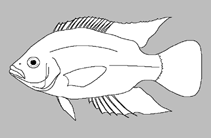
Spine dorsali (totale) : 17; Raggi dorsali molli (totale) : 10; Spine anali: 3; Raggi anali molli: 9. Diagnosis: Hemitaeniochromis brachyrhynchus is readily distinguished from its formal congener H. urotaenia, by its narrow lacrimal bone whose width, at the midpoint of the bone, is one-third of the orbit length, vs. nearly equal to the orbit length in H. urotaenia; by its snout being shorter than the orbit length, vs. longer in H. urotaenia; by its much larger eyes, the orbit length being about 36-38% of head length, vs. 22-28% in H. urotaenia; by its shorter lower jaw which is about 39-41% of head length, vs. 45-51% in H. urotaenia; and by its melanin pattern, which is composed of spots and line segments that are less well-defined than those of H. urotaenia (Ref. 91204). The narrow lacrimal and large eyes also distinguish H. brachyrhynchus from all other species that have sometimes been placed in Hemitaeniochromis (Ref. 91204).
Body shape (shape guide): fusiform / normal.
The distinctive lower-jaw teeth, with their outwardly and anteriorly angled crowns are similar to those of other haplochromine cichlids that have a paedophagous diet (Ref. 91204). The conservation status is unknown; it may normally inhabit deeper water than has generally been sampled over rocky substrates; and the widely separated localities of the two type specimens at least demonstrate that the species is not restricted to a single circumscribed area (Ref. 91204).
Ciclo vitale e comportamento di accoppiamento
Maturità | Riproduzione | Deposizione | Uova | Fecondità | Larve
Oliver, M.K., 2012. Hemitaenichromis brachyrhynchus, a new species of cichlid fish from Lake Malaŵi, with comments on some other supposed members of the genus (Teleostei: Cichlidae). Zootaxa 3410:35-50. (Ref. 91204)
Stato della Lista Rossa IUCN (Ref. 130435: Version 2025-2 (Global))
Minaccia per l'uomo
Harmless
Usi umani
Pesca: di nessun interesse
Strumenti
Rapporti speciali
Scarica XML
Fonti Internet
Stime basate su modelli
Indice di diversità filogenetica (Fonte Biblio.
82804): PD
50 = 0.7500 [Uniqueness, from 0.5 = low to 2.0 = high].
Bayesian length-weight: a=0.00389 (0.00180 - 0.00842), b=3.12 (2.94 - 3.30), in cm total length, based on all LWR estimates for this body shape (Ref.
93245).
Livello trofico (Fonte Biblio.
69278): 3.8 ±0.5 se; based on size and trophs of closest relatives
Resilienza (Fonte Biblio.
120179): Molto basso, tempo minimo di raddoppiamento della popolazione più di 14 anni (Preliminary K or Fecundity.).
Vulnerabilità della pesca (Ref.
59153): Very high vulnerability (90 of 100).
🛈