Classification / Noms
Noms communs | Synonymes | Catalog of Fishes(Genre, Espèce) | ITIS | CoL | WoRMS | Cloffa
>
Cichliformes (Cichlids, convict blennies) >
Cichlidae (Cichlids) > Pseudocrenilabrinae
Etymology: Hemitaeniochromis: Greek, hemi = half + Latin, taenia, -ae = strip + Greek, chromis = a fish, perhaps a perch (Ref. 45335); brachyrhynchus: Latinized from the Greek adjective βραχύσ, short, and noun ρύγχοσ, snout, in reference to the abbreviated preocular region of the head; brachyrhynchus is a noun in apposition (Ref. 91204).
Environnement : milieu / zone climatique / profondeur / gamme de distribution
Écologie
; eau douce pélagique. Tropical
Africa: Lake Malawi (Ref. 91204).
Taille / Poids / Âge
Maturité: Lm ? range ? - ? cm
Max length : 124 cm SL mâle / non sexé; (Ref. 91204)
Description synthétique
Clés d'identification | Morphologie | Morphométrie
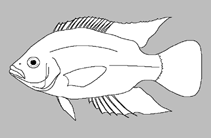
Épines dorsales (Total) : 17; Rayons mous dorsaux (Total) : 10; Épines anales: 3; Rayons mous anaux: 9. Diagnosis: Hemitaeniochromis brachyrhynchus is readily distinguished from its formal congener H. urotaenia, by its narrow lacrimal bone whose width, at the midpoint of the bone, is one-third of the orbit length, vs. nearly equal to the orbit length in H. urotaenia; by its snout being shorter than the orbit length, vs. longer in H. urotaenia; by its much larger eyes, the orbit length being about 36-38% of head length, vs. 22-28% in H. urotaenia; by its shorter lower jaw which is about 39-41% of head length, vs. 45-51% in H. urotaenia; and by its melanin pattern, which is composed of spots and line segments that are less well-defined than those of H. urotaenia (Ref. 91204). The narrow lacrimal and large eyes also distinguish H. brachyrhynchus from all other species that have sometimes been placed in Hemitaeniochromis (Ref. 91204).
Body shape (shape guide): fusiform / normal.
The distinctive lower-jaw teeth, with their outwardly and anteriorly angled crowns are similar to those of other haplochromine cichlids that have a paedophagous diet (Ref. 91204). The conservation status is unknown; it may normally inhabit deeper water than has generally been sampled over rocky substrates; and the widely separated localities of the two type specimens at least demonstrate that the species is not restricted to a single circumscribed area (Ref. 91204).
Cycle de vie et comportement reproducteur
Maturité | Reproduction | Frai | Œufs | Fécondité | Larves
Oliver, M.K., 2012. Hemitaenichromis brachyrhynchus, a new species of cichlid fish from Lake Malaŵi, with comments on some other supposed members of the genus (Teleostei: Cichlidae). Zootaxa 3410:35-50. (Ref. 91204)
Statut dans la liste rouge de l'IUCN (Ref. 130435: Version 2025-2 (Global))
Menace pour l'homme
Harmless
Utilisations par l'homme
Pêcheries: sans intérêt
Outils
Articles particuliers
Télécharger en XML
Sources Internet
Estimations basées sur des modèles
Indice de diversité phylogénétique (Réf.
82804): PD
50 = 0.7500 [Uniqueness, from 0.5 = low to 2.0 = high].
Bayesian length-weight: a=0.00389 (0.00180 - 0.00842), b=3.12 (2.94 - 3.30), in cm total length, based on all LWR estimates for this body shape (Ref.
93245).
Niveau trophique (Réf.
69278): 3.8 ±0.5 se; based on size and trophs of closest relatives
Résilience (Réf.
120179): Très faible, temps minimum de doublement de population supérieur à 14 ans (Preliminary K or Fecundity.).
Vulnérabilité de la pêche (Ref.
59153): Very high vulnerability (90 of 100).
🛈