分類 / 名前
共通名の | 類義語 | Catalog of Fishes(部類, 種) | ITIS | CoL | WoRMS | Cloffa
>
Cichliformes (Cichlids, convict blennies) >
Cichlidae (Cichlids) > Cichlinae
Etymology: Mazarunia: Taken from river Mazaruni; local habitat of this fish (Ref. 45335); pala: The specific name is from the Greek pala, meaning gold nugget. This is in reference to the golden spots behind and under the orbit and also to the fact that this species has only been collected in the main channel of the upper Mazaruni River, where a growing gold mining industry may be contributing to degradation of its habitat. To be regarded as an adjective in feminine form.
Eponymy: This is a toponym referring to the Mazaruni river system in Guyana. (Ref. 128868), visit book page.
環境:環境 / 気候帯 / 深さの範囲 / 分布範囲
生態学
; 新鮮な水; 汽水性の 底生の漂泳性; pH range: 4.4 - ?. Tropical; 22°C - 25°C (Ref. 91746)
South America: Upper Mazaruni River between the mouths of the Kukui and
Kamarang rivers in Guyana.
サイズ / 重さ / 年齢
成熟: Lm ? range ? - ? cm
Max length : 7.4 cm SL オス/雌雄の選別がない; (Ref. 91746)
簡単な記述
検索表 | 形態学 | 形態計測学
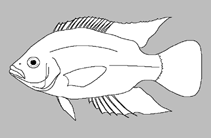
背面の脊椎 (合計) : 15 - 17; 背鰭 (合計) : 7 - 8; 肛門の骨: 3; 臀鰭: 7; 脊つい: 26. Based on phylogenetic analysis, this species is distinguished from its congeners by the derived absence of a parhypurapophysis (132-1). Based on external characters, it is diagnosable by the presence of a dorsal-fin scaly pad with ctenoid scales (vs. no scaly pad in Mazarunia charadrica and Mazarunia mazarunii), a small suborbital stripe that is limited to the preopercle, by the absence of clearly discernible lateral bars on the body, and by its general pinkish coloration with a midlateral spot as the only melanic marking (Ref. 91746).
Occurs mostly in or near the main upper Mazaruni River channel in localities with sandy or slightly muddy substrates with structure formed by submerged or emerging grass and other
riparian vegetation and some drift wood. Appears to move at night into shallow, flooded banks with terrestrial vegetation (Ref. 91746).
ライフサイクルと交尾行動
成熟 | 繁殖 | 放精 | 卵 | 生産力 | 幼生
López-Fernández, H., D.C. Taphorn and E.A. Liverpool, 2012. Phylogenetic diagnosis and expanded description of the genus Mazarunia Kullander, 1990 (Teleostei: Cichlidae) from the upper Mazaruni River, Guyana, with description of two new species. Neotrop. Ichthyol. 10(3):465-486. (Ref. 91746)
IUCNのレッドリストの状況は (Ref. 130435: Version 2025-2 (Global))
絶滅危惧 (EN) (B1ab(iii)); Date assessed: 01 November 2023
人間の用途
用具
特記事項
XMLをダウンロードして下さい
インターネットの情報源
モデルに基づく推定値
系統多様性指数 (参照
82804): PD
50 = 0.6250 [Uniqueness, from 0.5 = low to 2.0 = high].
Bayesian length-weight: a=0.03020 (0.01328 - 0.06866), b=3.03 (2.84 - 3.22), in cm total length, based on LWR estimates for this (Sub)family-body shape (Ref.
93245).
栄養段階 (参照
69278): 3.2 ±0.5 se; based on size and trophs of closest relatives
漁業の脆弱性 (Ref.
59153): Low vulnerability (10 of 100).
🛈