Klassifizierung / Names
Namen | Synonyme | Catalog of Fishes(Gattung, Arten) | ITIS | CoL | WoRMS | Cloffa
>
Cichliformes (Cichlids, convict blennies) >
Cichlidae (Cichlids) > Cichlinae
Etymology: Mazarunia: Taken from river Mazaruni; local habitat of this fish (Ref. 45335); pala: The specific name is from the Greek pala, meaning gold nugget. This is in reference to the golden spots behind and under the orbit and also to the fact that this species has only been collected in the main channel of the upper Mazaruni River, where a growing gold mining industry may be contributing to degradation of its habitat. To be regarded as an adjective in feminine form.
Eponymy: This is a toponym referring to the Mazaruni river system in Guyana. (Ref. 128868), visit book page.
Umwelt: Milieu / Klimazone / Tiefenbereich / Verbreitungsgebiet
Ökologie
; süßwasser; brackwasser benthopelagisch; pH range: 4.4 - ?. Tropical; 22°C - 25°C (Ref. 91746)
South America: Upper Mazaruni River between the mouths of the Kukui and
Kamarang rivers in Guyana.
Größe / Gewicht / Alter
Geschlechtsreife: Lm ? range ? - ? cm
Max length : 7.4 cm SL Männchen/unbestimmt; (Ref. 91746)
Kurzbeschreibung
Bestimmungsschlüssel | Morphologie | Morphometrie
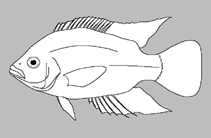
Rückenflossenstacheln (insgesamt) : 15 - 17; Rückenflossenweichstrahlen (insgesamt) : 7 - 8; Afterflossenstacheln: 3; Afterflossenweichstrahlen: 7; Wirbelzahl: 26. Based on phylogenetic analysis, this species is distinguished from its congeners by the derived absence of a parhypurapophysis (132-1). Based on external characters, it is diagnosable by the presence of a dorsal-fin scaly pad with ctenoid scales (vs. no scaly pad in Mazarunia charadrica and Mazarunia mazarunii), a small suborbital stripe that is limited to the preopercle, by the absence of clearly discernible lateral bars on the body, and by its general pinkish coloration with a midlateral spot as the only melanic marking (Ref. 91746).
Occurs mostly in or near the main upper Mazaruni River channel in localities with sandy or slightly muddy substrates with structure formed by submerged or emerging grass and other
riparian vegetation and some drift wood. Appears to move at night into shallow, flooded banks with terrestrial vegetation (Ref. 91746).
Lebenszyklus und Paarungsverhalten
Geschlechtsreife | Fortpflanzung | Ablaichen | Eier | Fruchtbarkeit | Larven
López-Fernández, H., D.C. Taphorn and E.A. Liverpool, 2012. Phylogenetic diagnosis and expanded description of the genus Mazarunia Kullander, 1990 (Teleostei: Cichlidae) from the upper Mazaruni River, Guyana, with description of two new species. Neotrop. Ichthyol. 10(3):465-486. (Ref. 91746)
IUCN Rote Liste Status (Ref. 130435: Version 2025-2 (Global))
Bedrohung für Menschen
Harmless
Nutzung durch Menschen
Tools
Zusatzinformationen
Download XML
Internet Quellen
Schätzungen auf der Grundlage von Modellen
Phylogenetischer Diversitätsindex (Ref.
82804): PD
50 = 0.6250 [Uniqueness, from 0.5 = low to 2.0 = high].
Bayesian length-weight: a=0.03020 (0.01328 - 0.06866), b=3.03 (2.84 - 3.22), in cm total length, based on LWR estimates for this (Sub)family-body shape (Ref.
93245).
Trophische Ebene (Ref.
69278): 3.2 ±0.5 se; based on size and trophs of closest relatives
Anfälligkeit der Fischerei (Ref.
59153): Low vulnerability (10 of 100).
🛈