Classification / Noms
Noms communs | Synonymes | Catalog of Fishes(Genre, Espèce) | ITIS | CoL | WoRMS | Cloffa
>
Cichliformes (Cichlids, convict blennies) >
Cichlidae (Cichlids) > Cichlinae
Etymology: Mazarunia: Taken from river Mazaruni; local habitat of this fish (Ref. 45335); pala: The specific name is from the Greek pala, meaning gold nugget. This is in reference to the golden spots behind and under the orbit and also to the fact that this species has only been collected in the main channel of the upper Mazaruni River, where a growing gold mining industry may be contributing to degradation of its habitat. To be regarded as an adjective in feminine form.
Eponymy: This is a toponym referring to the Mazaruni river system in Guyana. (Ref. 128868), visit book page.
Environnement : milieu / zone climatique / profondeur / gamme de distribution
Écologie
; eau douce; saumâtre benthopélagique; pH range: 4.4 - ?. Tropical; 22°C - 25°C (Ref. 91746)
South America: Upper Mazaruni River between the mouths of the Kukui and
Kamarang rivers in Guyana.
Taille / Poids / Âge
Maturité: Lm ? range ? - ? cm
Max length : 7.4 cm SL mâle / non sexé; (Ref. 91746)
Description synthétique
Clés d'identification | Morphologie | Morphométrie
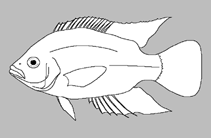
Épines dorsales (Total) : 15 - 17; Rayons mous dorsaux (Total) : 7 - 8; Épines anales: 3; Rayons mous anaux: 7; Vertèbres: 26. Based on phylogenetic analysis, this species is distinguished from its congeners by the derived absence of a parhypurapophysis (132-1). Based on external characters, it is diagnosable by the presence of a dorsal-fin scaly pad with ctenoid scales (vs. no scaly pad in Mazarunia charadrica and Mazarunia mazarunii), a small suborbital stripe that is limited to the preopercle, by the absence of clearly discernible lateral bars on the body, and by its general pinkish coloration with a midlateral spot as the only melanic marking (Ref. 91746).
Occurs mostly in or near the main upper Mazaruni River channel in localities with sandy or slightly muddy substrates with structure formed by submerged or emerging grass and other
riparian vegetation and some drift wood. Appears to move at night into shallow, flooded banks with terrestrial vegetation (Ref. 91746).
Cycle de vie et comportement reproducteur
Maturité | Reproduction | Frai | Œufs | Fécondité | Larves
López-Fernández, H., D.C. Taphorn and E.A. Liverpool, 2012. Phylogenetic diagnosis and expanded description of the genus Mazarunia Kullander, 1990 (Teleostei: Cichlidae) from the upper Mazaruni River, Guyana, with description of two new species. Neotrop. Ichthyol. 10(3):465-486. (Ref. 91746)
Statut dans la liste rouge de l'IUCN (Ref. 130435: Version 2025-2 (Global))
Menacé (EN) (B1ab(iii)); Date assessed: 01 November 2023
Menace pour l'homme
Harmless
Utilisations par l'homme
Outils
Articles particuliers
Télécharger en XML
Sources Internet
Estimations basées sur des modèles
Indice de diversité phylogénétique (Réf.
82804): PD
50 = 0.6250 [Uniqueness, from 0.5 = low to 2.0 = high].
Bayesian length-weight: a=0.03020 (0.01328 - 0.06866), b=3.03 (2.84 - 3.22), in cm total length, based on LWR estimates for this (Sub)family-body shape (Ref.
93245).
Niveau trophique (Réf.
69278): 3.2 ±0.5 se; based on size and trophs of closest relatives
Vulnérabilité de la pêche (Ref.
59153): Low vulnerability (10 of 100).
🛈