分类 / 名称
俗名 | 同种异名 | Catalog of Fishes(属, 种) | ITIS | CoL | WoRMS | Cloffa
Teleostei >
Siluriformes (Catfishes) >
Sisoridae (Sisorid catfishes) > Glyptosterninae
Etymology: Euchiloglanis: Greek, eu = good + Greek, cheilos = lip + Greek, glanis = a fish that can eat the bait without touching the hook; a cat fish (Ref. 45335); longibarbatus: From the Latin long, meaning long; barbatus, meaning barbel, in reference to the long maxillary barbel. A noun in apposition.
环境:氛围 / 气候带 / 深度上下限 / 分布范围
生态学
; 淡水 底中水层性. ; 31°N - 27°N
分布
领土 | FAO区域 | 生态系 | 标本纪录 | 分布图 | 简介 | Faunafri
Asia: China. Known from the Jinsha-Jiang drainage (upper Yangtze River basin, China), including the upper Jinsha-Jiang and the Yalong-Jiang (Ref. 86867).
大小 / 重量 / 年龄
成熟度: Lm ? range ? - ? cm
Max length : 20.0 cm SL 雄鱼/尚未辨别雌雄; (Ref. 86867)
简单描述
检索表 | 型态特徵 | 形态测量图
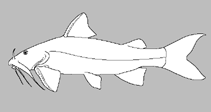
背棘 (总数) : 1; 背的软条 (总数) : 5; 臀棘: 1; 臀鳍软条: 5. Euchiloglanis longibarbatus differs from E. davidi, E. kishinouyei, and E. longus by having a pointed maxillary barbel, elongated as a thread, with the tip reaching posteriorly beyond the gill opening (vs. the maxillary barbel not elongated as a thread, with the tip only reaching to the gill opening. Euchiloglanis longibarbatus differs from E. kishinouyei, E. davidi and E. longus by having three indentations in the premaxillary tooth band, one in the middle and two on the sides (vs. E. kishinouyei without indentations; E. davidi and E. longus with a median indentation. It differs from E. davidi by having the length of the pectoral fin equal to 71.2–89.9% (vs. 90.5–117.1%) of the distance between the insertions of the pectoral and pelvic fins, and from E. davidi and E. longus by having the distance between the insertion of the pelvic fin and the anus equal to 75.5–92.2% (vs. 100.0–125.0 and 108.9–130.0% respectively) of the distance between the insertions of the pectoral and pelvic fins. Euchiloglanis longibarbatus differs from E. dorsoarcus by having the anal-fin origin closer to the caudal-fin base than to the pelvic-fin origin (vs. the anal-fin origin closer to the pelvic-fin origin than to the caudal-fin base), and from E. dorsoarcus and E. phongthoensis by having the anus located midway between the pelvic-fin insertion and the anal-fin origin (vs. the distance from the anus to pelvic-fin insertion equal to about 50% of the distance from the anus to the anal-fin origin). Euchiloglanis longibarbatus further differs from E. longus by having the depth of the caudal peduncle equal to 26.8–44.5% (vs. 14.1–27.0%) of the caudal-peduncle length (Ref. 86867).
Body shape (shape guide): elongated.
生命周期和交配行为
成熟度 | 繁殖 | 产卵场 | 卵 | 孕卵数 | 仔鱼
Zhou, W., X. Li and A.W. Thomson, 2011. Two new species of the Glyptosternine catfish genus Euchiloglanis (Teleostei: Sisoridae) from southwest China with redescriptions of E. davidi and E. kishinouyei. Zootaxa 2871:1-18. (Ref. 86867)
世界自然保护联盟红皮书 (Ref. 130435: Version 2025-2 (Global))
人类利用
工具
特别资料
下载 XML
网络资源
基于模型的估算
系统发育多样性指数 (参考文献
82804): PD
50 = 0.5625 [Uniqueness, from 0.5 = low to 2.0 = high].
Bayesian length-weight: a=0.00603 (0.00269 - 0.01352), b=3.08 (2.88 - 3.28), in cm total length, based on LWR estimates for this (Sub)family-body shape (Ref.
93245).
营养阶层 (参考文献
69278): 3.2 ±0.4 se; based on size and trophs of closest relatives
回复力 (参考文献
120179): 低的, 最小族群倍增时间4.5 - 14 年 (Preliminary K or Fecundity.).
渔业脆弱性 (Ref.
59153): Low vulnerability (14 of 100).
🛈