Ταξινόμηση / Ονόματα
Κοινά ονόματα | Συνώνυμα | Catalog of Fishes(Γένος, Είδη) | ITIS | CoL | WoRMS | Cloffa
>
Siluriformes (Catfishes) >
Sisoridae (Sisorid catfishes) > Glyptosterninae
Etymology: Euchiloglanis: Greek, eu = good + Greek, cheilos = lip + Greek, glanis = a fish that can eat the bait without touching the hook; a cat fish (Ref. 45335); longibarbatus: From the Latin long, meaning long; barbatus, meaning barbel, in reference to the long maxillary barbel. A noun in apposition.
Περιβάλλον: περιβάλλον / κλιματική ζώνη / εύρος βάθους / εύρος διανομής
Οικολογία
; Γλυκού νερού βενθοπελαγικό. Subtropical; 31°N - 27°N
Asia: China. Known from the Jinsha-Jiang drainage (upper Yangtze River basin, China), including the upper Jinsha-Jiang and the Yalong-Jiang (Ref. 86867).
Μέγεθος / Βάρος / Ηλικία
Γεννητική Ωρίμανση: Lm ? range ? - ? cm
Max length : 20.0 cm SL αρσενικό/απροσδιόριστο; (Ref. 86867)
Σύντομη περιγραφή
Κλείδες προσδιορισμού | Μορφολογία | Μορφομετρία
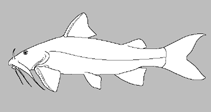
Ραχιαίες άκανθες (συνολικά) : 1; Μαλακές ραχιαίες ακτίνες (συνολικά) : 5; Εδρικές άκανθες: 1; Μαλακές εδρικές ακτίνες: 5. Euchiloglanis longibarbatus differs from E. davidi, E. kishinouyei, and E. longus by having a pointed maxillary barbel, elongated as a thread, with the tip reaching posteriorly beyond the gill opening (vs. the maxillary barbel not elongated as a thread, with the tip only reaching to the gill opening. Euchiloglanis longibarbatus differs from E. kishinouyei, E. davidi and E. longus by having three indentations in the premaxillary tooth band, one in the middle and two on the sides (vs. E. kishinouyei without indentations; E. davidi and E. longus with a median indentation. It differs from E. davidi by having the length of the pectoral fin equal to 71.2–89.9% (vs. 90.5–117.1%) of the distance between the insertions of the pectoral and pelvic fins, and from E. davidi and E. longus by having the distance between the insertion of the pelvic fin and the anus equal to 75.5–92.2% (vs. 100.0–125.0 and 108.9–130.0% respectively) of the distance between the insertions of the pectoral and pelvic fins. Euchiloglanis longibarbatus differs from E. dorsoarcus by having the anal-fin origin closer to the caudal-fin base than to the pelvic-fin origin (vs. the anal-fin origin closer to the pelvic-fin origin than to the caudal-fin base), and from E. dorsoarcus and E. phongthoensis by having the anus located midway between the pelvic-fin insertion and the anal-fin origin (vs. the distance from the anus to pelvic-fin insertion equal to about 50% of the distance from the anus to the anal-fin origin). Euchiloglanis longibarbatus further differs from E. longus by having the depth of the caudal peduncle equal to 26.8–44.5% (vs. 14.1–27.0%) of the caudal-peduncle length (Ref. 86867).
Body shape (shape guide): elongated.
Κύκλος ζωής και συμπεριφορά ζευγαρώματος
Γεννητική Ωρίμανση | Αναπαραγωγή | Γεννοβολία | Αβγά | Γονιμότητα | Προνύμφες
Zhou, W., X. Li and A.W. Thomson, 2011. Two new species of the Glyptosternine catfish genus Euchiloglanis (Teleostei: Sisoridae) from southwest China with redescriptions of E. davidi and E. kishinouyei. Zootaxa 2871:1-18. (Ref. 86867)
Κατάσταση Κόκκινου Καταλόγου IUCN (Ref. 130435: Version 2025-2 (Global))
Απειλή για τον άνθρωπο
Harmless
Ανθρώπινες χρήσεις
Εργαλεία
Ειδικές εκθέσεις
Λήψη XML
Διαδικτυακές πηγές
Εκτιμήσεις βάσει μοντέλων
Δείκτης φυλογενετικής ποικιλότητας (Αναφ.
82804): PD
50 = 0.5625 [Uniqueness, from 0.5 = low to 2.0 = high].
Bayesian length-weight: a=0.00603 (0.00269 - 0.01352), b=3.08 (2.88 - 3.28), in cm total length, based on LWR estimates for this (Sub)family-body shape (Ref.
93245).
Τροφικό Επίπεδο (Αναφ.
69278): 3.2 ±0.4 se; based on size and trophs of closest relatives
Ελαστικότητα (Αναφ.
120179): Χαμηλό, ελάχιστος χρόνος για διπλασιασμό πληθυσμού 4,5 - 14 έτη (Preliminary K or Fecundity.).
Ευπάθεια στην αλιεία (Ref.
59153): Low vulnerability (14 of 100).
🛈