Classificação / Nomes
Nomes comuns | Sinônimos | Catalog of Fishes(Gênero, Espécies) | ITIS | CoL | WoRMS | Cloffa
>
Siluriformes (Catfishes) >
Sisoridae (Sisorid catfishes) > Glyptosterninae
Etymology: Euchiloglanis: Greek, eu = good + Greek, cheilos = lip + Greek, glanis = a fish that can eat the bait without touching the hook; a cat fish (Ref. 45335); longibarbatus: From the Latin long, meaning long; barbatus, meaning barbel, in reference to the long maxillary barbel. A noun in apposition.
Meio ambiente: milieu / Zona climática / intervalo de profundidade / faixa de distribuição
Ecologia
; Água doce bentopelágico. Subtropical; 31°N - 27°N
Asia: China. Known from the Jinsha-Jiang drainage (upper Yangtze River basin, China), including the upper Jinsha-Jiang and the Yalong-Jiang (Ref. 86867).
Tamanho / Peso / Idade
Maturidade: Lm ? range ? - ? cm
Max length : 20.0 cm SL macho/indeterminado; (Ref. 86867)
Descrição suscinta
Chaves de identificação | Morfologia | Morfometria
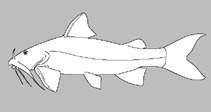
Espinhos dorsais (total) : 1; Raios dorsais (total) : 5; Espinhos anais: 1; Raios anais : 5. Euchiloglanis longibarbatus differs from E. davidi, E. kishinouyei, and E. longus by having a pointed maxillary barbel, elongated as a thread, with the tip reaching posteriorly beyond the gill opening (vs. the maxillary barbel not elongated as a thread, with the tip only reaching to the gill opening. Euchiloglanis longibarbatus differs from E. kishinouyei, E. davidi and E. longus by having three indentations in the premaxillary tooth band, one in the middle and two on the sides (vs. E. kishinouyei without indentations; E. davidi and E. longus with a median indentation. It differs from E. davidi by having the length of the pectoral fin equal to 71.2–89.9% (vs. 90.5–117.1%) of the distance between the insertions of the pectoral and pelvic fins, and from E. davidi and E. longus by having the distance between the insertion of the pelvic fin and the anus equal to 75.5–92.2% (vs. 100.0–125.0 and 108.9–130.0% respectively) of the distance between the insertions of the pectoral and pelvic fins. Euchiloglanis longibarbatus differs from E. dorsoarcus by having the anal-fin origin closer to the caudal-fin base than to the pelvic-fin origin (vs. the anal-fin origin closer to the pelvic-fin origin than to the caudal-fin base), and from E. dorsoarcus and E. phongthoensis by having the anus located midway between the pelvic-fin insertion and the anal-fin origin (vs. the distance from the anus to pelvic-fin insertion equal to about 50% of the distance from the anus to the anal-fin origin). Euchiloglanis longibarbatus further differs from E. longus by having the depth of the caudal peduncle equal to 26.8–44.5% (vs. 14.1–27.0%) of the caudal-peduncle length (Ref. 86867).
Body shape (shape guide): elongated.
Ciclo de vida ou comportamento de acasalamento
Maturidade | Reprodução | Desova | Ovos | Fecundidade | Larvas
Zhou, W., X. Li and A.W. Thomson, 2011. Two new species of the Glyptosternine catfish genus Euchiloglanis (Teleostei: Sisoridae) from southwest China with redescriptions of E. davidi and E. kishinouyei. Zootaxa 2871:1-18. (Ref. 86867)
Status na Lista Vermelha da UICN (Ref. 130435: Version 2025-2 (Global))
Ameaça para os humanos
Harmless
Uso pelos humanos
Ferramentas
Relatórios especiais
Baixar XML
Fontes da internet
Estimativas baseadas em modelos
Índice de diversidade filogenética (Ref.
82804): PD
50 = 0.5625 [Uniqueness, from 0.5 = low to 2.0 = high].
Bayesian length-weight: a=0.00603 (0.00269 - 0.01352), b=3.08 (2.88 - 3.28), in cm total length, based on LWR estimates for this (Sub)family-body shape (Ref.
93245).
Nível Trófico (Ref.
69278): 3.2 ±0.4 se; based on size and trophs of closest relatives
Resiliência (Ref.
120179): Baixo, tempo mínimo de duplicação da população 4,5 - 14 anos (Preliminary K or Fecundity.).
Vulnerabilidade da pesca (Ref.
59153): Low vulnerability (14 of 100).
🛈