This website uses cookies to enhance your browsing experience and ensure the functionality of our site. For more detailed information about the types of cookies we use and how we protect your privacy, please visit our Privacy Information page.
×
Cookie Settings
This website uses different types of cookies to enhance your experience. Please select your preferences below:
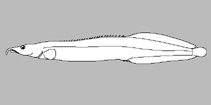
No image available for this species; drawing shows typical species in Mastacembelidae.
分類 / 名前 共通名の | 類義語 | Catalog of Fishes(部類, 種) | ITIS | CoL | WoRMS | Cloffa
> Synbranchiformes (Spiny eels) > Mastacembelidae (Spiny eels)
Etymology: Mastacembelus:Greek, mastax, -agos = bite + Greek, emballo = to throw oneself (Ref. 45335); apectoralis:The species name, apectoralis, an adjective, alludes to the absence of pectoral fins, and is formed from the Latin 'a', meaning without, and 'pectoralis', a Latinized version of pectoral (Ref. 86808).
背面の脊椎 (合計) : 32 - 34; 背鰭 (合計) : 58 - 69; 肛門の骨: 3; 臀鰭: 66 - 67; 脊つい: 77 - 80. Diagnosis: Mastacembelus apectoralis differs from all other mastacembelid species by the absence of pectoral fins (Ref. 86808). It is endemic to Lake Tanganyika and is placed within the Lake Tanganyika species flock; it differs from other members of this radiation by a near absence of scales, present only on the margin of the caudal peduncle and between caudal-fin rays, a very short rostral appendage and well-developed adductor mandibulae muscles forming a distinctive head shape; the lack of pigmentation distinguishes this species from all other Tanganyikan species, with the exception of M. micropectus and M. cunningtoni, although the latter species has a distinctive dark spot on the caudal and pectoral fins; both M. apectoralis and its sister species, M. micropectus, lack teeth on the palatine; Mastacembelus apectoralis has 32-34 dorsal spines, and based on this count, is distinguished from five other species in the Lake Tanganyika flock, M. platysoma, M. zebratus, M. polli, M. cunningtoni and M. moorii, which have fewer spines, 21-29; however, all other Lake Tanganyika species have overlapping spine count ranges, 24-38, at least in part with that of M. apectoralis; vertebral counts of M. apectoralis, 77-80, are in the region of those of M. micropectus and M. albomaculatus, are greater than M. zebratus, but are lower than other Tanganyikan species (Ref. 86808).
Body shape (shape guide): eel-like; Cross section: circular.
Found in a complex rocky habitat, consisting of multiple layers of rock, at a depth of 3-7 m (Ref. 86808).
Brown, K.J., R. Britz, R. Bills, L. Rüber and J.J. Day, 2011. Pectoral fin loss in the Mastacembelidae: a new species from Lake Tanganyika. J. Zool. 284(4):286-293. (Ref. 86808)
IUCNのレッドリストの状況は (Ref. 130435: Version 2025-2 (Global))
系統多様性指数 (参照 82804): PD50 = 0.5000 [Uniqueness, from 0.5 = low to 2.0 = high].
Bayesian length-weight: a=0.00269 (0.00129 - 0.00562), b=2.94 (2.76 - 3.12), in cm total length, based on LWR estimates for this (Sub)family-body shape (Ref. 93245).
栄養段階 (参照 69278): 3.6 ±0.6 se; based on size and trophs of closest relatives
回復力 (参照 120179): 高い, 15か月以下の倍増期間の最小個体群 (Preliminary K or Fecundity.).
漁業の脆弱性 (Ref. 59153): Low vulnerability (10 of 100). 🛈