Ταξινόμηση / Ονόματα
Κοινά ονόματα | Συνώνυμα | Catalog of Fishes(Γένος, Είδη) | ITIS | CoL | WoRMS | Cloffa
>
Synbranchiformes (Spiny eels) >
Mastacembelidae (Spiny eels)
Etymology: Mastacembelus: Greek, mastax, -agos = bite + Greek, emballo = to throw oneself (Ref. 45335); apectoralis: The species name, apectoralis, an adjective, alludes to the absence of pectoral fins, and is formed from the Latin 'a', meaning without, and 'pectoralis', a Latinized version of pectoral (Ref. 86808).
Περιβάλλον: περιβάλλον / κλιματική ζώνη / εύρος βάθους / εύρος διανομής
Οικολογία
; Γλυκού νερού βενθοπελαγικό; εύρος βάθους 3 - 7 m (Ref. 86808). Tropical
Africa: Lake Tanganyika in Zambia (Ref. 86808).
Μέγεθος / Βάρος / Ηλικία
Γεννητική Ωρίμανση: Lm ? range ? - ? cm
Max length : 16.3 cm SL αρσενικό/απροσδιόριστο; (Ref. 86808)
Σύντομη περιγραφή
Κλείδες προσδιορισμού | Μορφολογία | Μορφομετρία
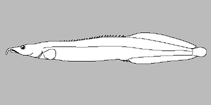
Ραχιαίες άκανθες (συνολικά) : 32 - 34; Μαλακές ραχιαίες ακτίνες (συνολικά) : 58 - 69; Εδρικές άκανθες: 3; Μαλακές εδρικές ακτίνες: 66 - 67; Σπόνδυλοι: 77 - 80. Diagnosis: Mastacembelus apectoralis differs from all other mastacembelid species by the absence of pectoral fins (Ref. 86808). It is endemic to Lake Tanganyika and is placed within the Lake Tanganyika species flock; it differs from other members of this radiation by a near absence of scales, present only on the margin of the caudal peduncle and between caudal-fin rays, a very short rostral appendage and well-developed adductor mandibulae muscles forming a distinctive head shape; the lack of pigmentation distinguishes this species from all other Tanganyikan species, with the exception of M. micropectus and M. cunningtoni, although the latter species has a distinctive dark spot on the caudal and pectoral fins; both M. apectoralis and its sister species, M. micropectus, lack teeth on the palatine; Mastacembelus apectoralis has 32-34 dorsal spines, and based on this count, is distinguished from five other species in the Lake Tanganyika flock, M. platysoma, M. zebratus, M. polli, M. cunningtoni and M. moorii, which have fewer spines, 21-29; however, all other Lake Tanganyika species have overlapping spine count ranges, 24-38, at least in part with that of M. apectoralis; vertebral counts of M. apectoralis, 77-80, are in the region of those of M. micropectus and M. albomaculatus, are greater than M. zebratus, but are lower than other Tanganyikan species (Ref. 86808).
Body shape (shape guide): eel-like; Cross section: circular.
Found in a complex rocky habitat, consisting of multiple layers of rock, at a depth of 3-7 m (Ref. 86808).
Κύκλος ζωής και συμπεριφορά ζευγαρώματος
Γεννητική Ωρίμανση | Αναπαραγωγή | Γεννοβολία | Αβγά | Γονιμότητα | Προνύμφες
Brown, K.J., R. Britz, R. Bills, L. Rüber and J.J. Day, 2011. Pectoral fin loss in the Mastacembelidae: a new species from Lake Tanganyika. J. Zool. 284(4):286-293. (Ref. 86808)
Κατάσταση Κόκκινου Καταλόγου IUCN (Ref. 130435: Version 2025-2 (Global))
Απειλή για τον άνθρωπο
Harmless
Ανθρώπινες χρήσεις
Εργαλεία
Ειδικές εκθέσεις
Λήψη XML
Διαδικτυακές πηγές
Εκτιμήσεις βάσει μοντέλων
Δείκτης φυλογενετικής ποικιλότητας (Αναφ.
82804): PD
50 = 0.5000 [Uniqueness, from 0.5 = low to 2.0 = high].
Bayesian length-weight: a=0.00269 (0.00129 - 0.00562), b=2.94 (2.76 - 3.12), in cm total length, based on LWR estimates for this (Sub)family-body shape (Ref.
93245).
Τροφικό Επίπεδο (Αναφ.
69278): 3.6 ±0.6 se; based on size and trophs of closest relatives
Ελαστικότητα (Αναφ.
120179): Υψηλό, ελάχιστος χρόνος για διπλασιασμό πληθυσμού < 15 μήνες (Preliminary K or Fecundity.).
Ευπάθεια στην αλιεία (Ref.
59153): Low vulnerability (10 of 100).
🛈