التصنيف / الأسماء
الأسماء الشائعة | مرادفات | Catalog of Fishes(جنس, الانواع) | ITIS | CoL | WoRMS | Cloffa
>
Synbranchiformes (Spiny eels) >
Mastacembelidae (Spiny eels)
Etymology: Mastacembelus: Greek, mastax, -agos = bite + Greek, emballo = to throw oneself (Ref. 45335); apectoralis: The species name, apectoralis, an adjective, alludes to the absence of pectoral fins, and is formed from the Latin 'a', meaning without, and 'pectoralis', a Latinized version of pectoral (Ref. 86808).
البيئة: الوسط / المنطقة المناخية / نطاق العمق / نطاق التوزيع
البيئة
; المياه العذبة قاعية التغذية و المعيشة; نطاق العمق 3 - 7 m (Ref. 86808). Tropical
Africa: Lake Tanganyika in Zambia (Ref. 86808).
الحجم / وزن / العمر
النضج: Lm ? range ? - ? cm
Max length : 16.3 cm SL ذكر/ مختلط الجنس; (Ref. 86808)
وصف مختصر
مفاتيح التعريف | الوصف الخارجي | قياسات المظهر الخارجي
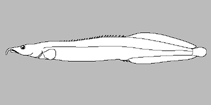
الأشواك الظهرية (المجموع) : 32 - 34; الأشعة الظهرية الناعمة (المجموع) : 58 - 69; شوكة شرجية: 3; أشعه شرجية لينه: 66 - 67; فقرات: 77 - 80. Diagnosis: Mastacembelus apectoralis differs from all other mastacembelid species by the absence of pectoral fins (Ref. 86808). It is endemic to Lake Tanganyika and is placed within the Lake Tanganyika species flock; it differs from other members of this radiation by a near absence of scales, present only on the margin of the caudal peduncle and between caudal-fin rays, a very short rostral appendage and well-developed adductor mandibulae muscles forming a distinctive head shape; the lack of pigmentation distinguishes this species from all other Tanganyikan species, with the exception of M. micropectus and M. cunningtoni, although the latter species has a distinctive dark spot on the caudal and pectoral fins; both M. apectoralis and its sister species, M. micropectus, lack teeth on the palatine; Mastacembelus apectoralis has 32-34 dorsal spines, and based on this count, is distinguished from five other species in the Lake Tanganyika flock, M. platysoma, M. zebratus, M. polli, M. cunningtoni and M. moorii, which have fewer spines, 21-29; however, all other Lake Tanganyika species have overlapping spine count ranges, 24-38, at least in part with that of M. apectoralis; vertebral counts of M. apectoralis, 77-80, are in the region of those of M. micropectus and M. albomaculatus, are greater than M. zebratus, but are lower than other Tanganyikan species (Ref. 86808).
Body shape (shape guide): eel-like; Cross section: circular.
Found in a complex rocky habitat, consisting of multiple layers of rock, at a depth of 3-7 m (Ref. 86808).
دورة الحياة وسلوك التزاوج
النضج | التكاثر | وضع البيض | بيض | الخصوبة | اليرقات
Brown, K.J., R. Britz, R. Bills, L. Rüber and J.J. Day, 2011. Pectoral fin loss in the Mastacembelidae: a new species from Lake Tanganyika. J. Zool. 284(4):286-293. (Ref. 86808)
حالة القائمة الحمراء للاتحاد الدولي لحفظ الطبيعة والموارد الطبيعية (Ref. 130435: Version 2025-2 (Global))
استخدامات بشرية
أدوات
تقارير خاصة
تنزيل XML
مصادر علي الأنترنت
تقديرات تستند إلى النماذج
مؤشر التنوع الشُعبي الوراثي (مرجع
82804): PD
50 = 0.5000 [Uniqueness, from 0.5 = low to 2.0 = high].
Bayesian length-weight: a=0.00269 (0.00129 - 0.00562), b=2.94 (2.76 - 3.12), in cm total length, based on LWR estimates for this (Sub)family-body shape (Ref.
93245).
مستوى غذائي (مرجع
69278): 3.6 ±0.6 se; based on size and trophs of closest relatives
المرونه (مرجع
120179): عالي, الحد الزمني الأدني لتضاعف عدد أفراد المجتمع أقل من 15 شهر (Preliminary K or Fecundity.).
ضعف الصيد (Ref.
59153): Low vulnerability (10 of 100).
🛈