Milieu: milieu / Klimaatzone / Diepte / verspreidingsgebied
Ecologie
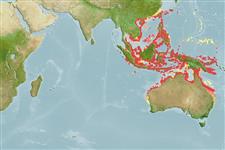
marien; brak water rifbewoner; diepte 1 - 30 m (Ref. 48636). Tropical; 27°N - 30°S, 100°E - 155°E (Ref. 5222)
Western Pacific: Thailand, Hong Kong, and Taiwan to Australia (Western Australia, Northern Territory, Queensland and New South Wales) and eastward to the Solomon and Mariana Islands, including Indonesia, Singapore, Philippines, Papua New Guinea, and Palau. Adults often misidentified as Epinephelus macrospilos.
Lengte bij maturiteit / Grootte / Gewicht / Leeftijd
Maturiteit: Lm ?, range 29 - ? cm
Max length : 49.0 cm TL mannelijk / geslacht onbekend; (Ref. 5222)
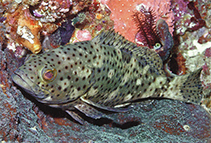
Dorsale stekels (totaal) : 11; Dorsale zachte stralen (totaal) : 15 - 17; Anale stekels: 3; Anale zachte stralen: 8. This species is distinguished by the following characters: greatest depth of body 2.9-3.2 in SL; ctenoid scales on body except cycloid scales anterodorsally and ventrally; body with auxiliary scales; gill rakers 8-10 + 14-17; pectoral-fin length 1.5-1.7 times in head length; rounded caudal fin; short pelvic fins, 1.8-2.3 in head length. Colour pale grey (sometimes with diffused white blotches) with small, widely spread black spots smaller than pupil on head, body and fins; 3 dusky to blackish blotches on body at base of rear half of dorsal fin, the largest at base of last 2-3 spines; dusky to blackish saddle spot on caudal peduncle; juveniles with black-edged white spots on head and body (Ref. 39231, 90102).
Body shape (shape guide): fusiform / normal; Cross section: compressed.
Common in shallow silty coastal reefs, sometimes in estuarine areas. The ovary was well developed in an examined fish of 30 cm SL. Solitary or in small groups (Ref 90102).
Levenscyclus en paargedrag
Maturiteit | Voortplanting | Paaien | Eieren | Fecunditeit | Larven
Heemstra, P.C. and J.E. Randall, 1993. FAO Species Catalogue. Vol. 16. Groupers of the world (family Serranidae, subfamily Epinephelinae). An annotated and illustrated catalogue of the grouper, rockcod, hind, coral grouper and lyretail species known to date. Rome: FAO. FAO Fish. Synop. 125(16):382 p. (Ref. 5222)
Status op de Rode Lijst van het IUCN (Ref. 130435: Version 2025-2 (Global))
Gevaar voor de mens
Harmless
Gebruik door de mens
Visserij: visserij voor eigen gebruik
Tools
Speciale rapporten
Download XML
Internetbronnen
Schattingen op basis van modellen
Gewenste temperatuur (Ref.
123201): 25.5 - 29.2, mean 28.6 °C (based on 1883 cells).
Fylogenetische diversiteitsindex (Ref.
82804): PD
50 = 0.5000 [Uniqueness, from 0.5 = low to 2.0 = high].
Bayesian length-weight: a=0.01148 (0.00555 - 0.02374), b=3.04 (2.87 - 3.21), in cm total length, based on LWR estimates for this Genus-body shape (Ref.
93245).
Trofisch niveau (Ref.
69278): 3.8 ±0.6 se; based on size and trophs of closest relatives
Weerstandsvermogen (Ref.
120179): Gemiddeld, minimale populatieverdubbelingstijd 1,4-4,4 jaar (Preliminary K or Fecundity.).
Kwetsbaarheid van de visserij (Ref.
59153): Moderate vulnerability (39 of 100).
🛈
Voedingsstoffen (Ref.
124155): Calcium = 30 [13, 62] mg/100g; Iron = 0.479 [0.257, 0.996] mg/100g; Protein = 18.8 [17.2, 20.2] %; Omega3 = 0.125 [0.077, 0.201] g/100g; Selenium = 28 [16, 51] μg/100g; VitaminA = 189 [47, 785] μg/100g; Zinc = 1.58 [1.05, 2.21] mg/100g (wet weight);