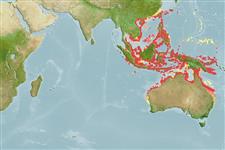
Lingkungan: lingkungan / zona iklim / kisaran kedalaman / jangkauan distribusi
Ekologi
laut; payau berasosiasi dengan karang; kisaran kedalaman 1 - 30 m (Ref. 48636). Tropical; 27°N - 30°S, 100°E - 155°E (Ref. 5222)
Western Pacific: Thailand, Hong Kong, and Taiwan to Australia (Western Australia, Northern Territory, Queensland and New South Wales) and eastward to the Solomon and Mariana Islands, including Indonesia, Singapore, Philippines, Papua New Guinea, and Palau. Adults often misidentified as Epinephelus macrospilos.
Panjang pada saat jatuh tempo pertama / Ukuran / Berat / umur
Kematangan: Lm ?, range 29 - ? cm
Max length : 49.0 cm TL jantan/; (Ref. 5222)
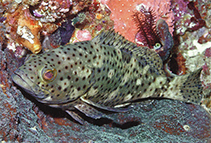
Duri punggung (Keseluruhan (total)) : 11; duri punggung lunak (Keseluruhan (total)) : 15 - 17; Duri dubur: 3; Sirip dubur lunak: 8. This species is distinguished by the following characters: greatest depth of body 2.9-3.2 in SL; ctenoid scales on body except cycloid scales anterodorsally and ventrally; body with auxiliary scales; gill rakers 8-10 + 14-17; pectoral-fin length 1.5-1.7 times in head length; rounded caudal fin; short pelvic fins, 1.8-2.3 in head length. Colour pale grey (sometimes with diffused white blotches) with small, widely spread black spots smaller than pupil on head, body and fins; 3 dusky to blackish blotches on body at base of rear half of dorsal fin, the largest at base of last 2-3 spines; dusky to blackish saddle spot on caudal peduncle; juveniles with black-edged white spots on head and body (Ref. 39231, 90102).
Body shape (shape guide): fusiform / normal; Cross section: compressed.
Common in shallow silty coastal reefs, sometimes in estuarine areas. The ovary was well developed in an examined fish of 30 cm SL. Solitary or in small groups (Ref 90102).
Siklus hidup dan perilaku kawin
Kematangan | Reproduksi, perkembang biakan | Pemijahan | telur-telur | Fekunditas | Larva
Heemstra, P.C. and J.E. Randall, 1993. FAO Species Catalogue. Vol. 16. Groupers of the world (family Serranidae, subfamily Epinephelinae). An annotated and illustrated catalogue of the grouper, rockcod, hind, coral grouper and lyretail species known to date. Rome: FAO. FAO Fish. Synop. 125(16):382 p. (Ref. 5222)
Status IUCN Red List (Ref. 130435: Version 2025-2 (Global))
ancaman kepada manusia
Harmless
penggunaan manusia
Perikanan: perikanan swasembada
Alat, peralatan
laporan khas
muat turun XML
Sumber internet
Estimasi berdasarkan model
Suhu yang disukai (Acuan
123201): 25.5 - 29.2, mean 28.6 °C (based on 1883 cells).
Indeks keanekaragaman filogenetik (Acuan
82804): PD
50 = 0.5000 [Uniqueness, from 0.5 = low to 2.0 = high].
Bayesian length-weight: a=0.01148 (0.00555 - 0.02374), b=3.04 (2.87 - 3.21), in cm total length, based on LWR estimates for this Genus-body shape (Ref.
93245).
Tingkat Trofik (Acuan
69278): 3.8 ±0.6 se; based on size and trophs of closest relatives
Daya lenting (Acuan
120179): sedang, Waktu penggandaan populasi minimum 1.4 - 4.4 tahun (Preliminary K or Fecundity.).
Kerentanan Penangkapan Ikan (Ref.
59153): Moderate vulnerability (39 of 100).
🛈
Nutrisi (Ref.
124155): Calcium = 30 [13, 62] mg/100g; Iron = 0.479 [0.257, 0.996] mg/100g; Protein = 18.8 [17.2, 20.2] %; Omega3 = 0.125 [0.077, 0.201] g/100g; Selenium = 28 [16, 51] μg/100g; VitaminA = 189 [47, 785] μg/100g; Zinc = 1.58 [1.05, 2.21] mg/100g (wet weight);