Classificazione / Nomi
Nomi Comuni | Sinonimi | Catalog of Fishes(Genere, Specie) | ITIS | CoL | WoRMS | Cloffa
Ambiente: milieu / zona climatica / distribuzione batimetrica / gamma di distribuzione
Ecologia
; acqua dolce benthopelagico. Tropical
South America: Rio Gorutuba floodplains, upper rio Verde Grande drainage in Brazil.
Dimensione / Peso / Età
Maturità: Lm ? range ? - ? cm
Max length : 3.9 cm SL maschio/sesso non determinato; (Ref. 89836)
Breve descrizione
Chiavi di identificazione | Morfologia | Morfometria
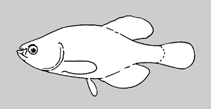
Distinguished from all members of Hypsolebias flavicaudatus complex, except H. nitens and H. sertanejo, by the presence of elongated bluish white spots on the posterior portion of the dorsal-fin base in males (vs. spots not elongated); whereas the spots are only slightly elongated in H. nitens and H. sertanejo, the spots in H. janaubensis are uniquely elongate, approximately as long as spots of the anterior portion of the fin. Can be separated from H. nitens and H. sertanejo by having the dorsal-fin origin on a vertical between the base of the first and second anal-fin rays in females (vs. between second and seventh rays), besides the dorsal-fin origin usually being anterior to anal-fin origin in males (vs. always posterior); and body more slender in males (body depth 33.9-38.4% SL vs. 39.7-43.2% SL; caudal peduncle depth 12.6-14.3% SL vs. 14.8-17.3% SL. Also differs from H. nitens, H. flavicaudatus and H. gilbertobrasili by having grey bars of flank narrower than interspace (vs. wider); from H. nitens, H. gilbertobrasili and H. guanambi, in having dorsal and anal-fin filaments reaching the posterior margin of the caudal fin (vs. reaching the basal portion of the fin); from H. nitens and H. flavicaudatus, in having the largest spots of middle portion of the flank larger than pupil (vs. smaller); and from H. radiseriatus, H. pterophyllus and H. flagellatus by having fewer dorsal fin filaments (2-3 vs. 4-6).
Body shape (shape guide): short and / or deep.
Ciclo vitale e comportamento di accoppiamento
Maturità | Riproduzione | Deposizione | Uova | Fecondità | Larve
Costa, W.J.E.M., P.F. Amorim and J.L. Mattos, 2012. Species delimitation in annual killifishes from the Brazilian Caatinga, the Hypsolebias flavicaudatus complex (Cypriniformes: Rivulidae): implications for taxonomy and conservation. Systematics and Biodiversity 10(1):71-91. (Ref. 89836)
Stato della Lista Rossa IUCN (Ref. 130435: Version 2025-2 (Global))
Minaccia per l'uomo
Harmless
Usi umani
Strumenti
Rapporti speciali
Scarica XML
Fonti Internet
Stime basate su modelli
Indice di diversità filogenetica (Fonte Biblio.
82804): PD
50 = 0.5000 [Uniqueness, from 0.5 = low to 2.0 = high].
Bayesian length-weight: a=0.01995 (0.00906 - 0.04395), b=3.01 (2.83 - 3.19), in cm total length, based on all LWR estimates for this body shape (Ref.
93245).
Livello trofico (Fonte Biblio.
69278): 3.2 ±0.4 se; based on size and trophs of closest relatives
Resilienza (Fonte Biblio.
120179): Alto, tempo minimo di raddoppiamento della popolazione meno di 15 mesi (Preliminary K or Fecundity.).
Vulnerabilità della pesca (Ref.
59153): Low vulnerability (10 of 100).
🛈