Klassifizierung / Names
Namen | Synonyme | Catalog of Fishes(Gattung, Arten) | ITIS | CoL | WoRMS | Cloffa
Umwelt: Milieu / Klimazone / Tiefenbereich / Verbreitungsgebiet
Ökologie
; süßwasser benthopelagisch. Tropical
South America: Rio Gorutuba floodplains, upper rio Verde Grande drainage in Brazil.
Größe / Gewicht / Alter
Geschlechtsreife: Lm ? range ? - ? cm
Max length : 3.9 cm SL Männchen/unbestimmt; (Ref. 89836)
Kurzbeschreibung
Bestimmungsschlüssel | Morphologie | Morphometrie
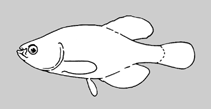
Distinguished from all members of Hypsolebias flavicaudatus complex, except H. nitens and H. sertanejo, by the presence of elongated bluish white spots on the posterior portion of the dorsal-fin base in males (vs. spots not elongated); whereas the spots are only slightly elongated in H. nitens and H. sertanejo, the spots in H. janaubensis are uniquely elongate, approximately as long as spots of the anterior portion of the fin. Can be separated from H. nitens and H. sertanejo by having the dorsal-fin origin on a vertical between the base of the first and second anal-fin rays in females (vs. between second and seventh rays), besides the dorsal-fin origin usually being anterior to anal-fin origin in males (vs. always posterior); and body more slender in males (body depth 33.9-38.4% SL vs. 39.7-43.2% SL; caudal peduncle depth 12.6-14.3% SL vs. 14.8-17.3% SL. Also differs from H. nitens, H. flavicaudatus and H. gilbertobrasili by having grey bars of flank narrower than interspace (vs. wider); from H. nitens, H. gilbertobrasili and H. guanambi, in having dorsal and anal-fin filaments reaching the posterior margin of the caudal fin (vs. reaching the basal portion of the fin); from H. nitens and H. flavicaudatus, in having the largest spots of middle portion of the flank larger than pupil (vs. smaller); and from H. radiseriatus, H. pterophyllus and H. flagellatus by having fewer dorsal fin filaments (2-3 vs. 4-6).
Body shape (shape guide): short and / or deep.
Lebenszyklus und Paarungsverhalten
Geschlechtsreife | Fortpflanzung | Ablaichen | Eier | Fruchtbarkeit | Larven
Costa, W.J.E.M., P.F. Amorim and J.L. Mattos, 2012. Species delimitation in annual killifishes from the Brazilian Caatinga, the Hypsolebias flavicaudatus complex (Cypriniformes: Rivulidae): implications for taxonomy and conservation. Systematics and Biodiversity 10(1):71-91. (Ref. 89836)
IUCN Rote Liste Status (Ref. 130435: Version 2025-2 (Global))
Bedrohung für Menschen
Harmless
Nutzung durch Menschen
Tools
Zusatzinformationen
Download XML
Internet Quellen
Schätzungen auf der Grundlage von Modellen
Phylogenetischer Diversitätsindex (Ref.
82804): PD
50 = 0.5000 [Uniqueness, from 0.5 = low to 2.0 = high].
Bayesian length-weight: a=0.01995 (0.00906 - 0.04395), b=3.01 (2.83 - 3.19), in cm total length, based on all LWR estimates for this body shape (Ref.
93245).
Trophische Ebene (Ref.
69278): 3.2 ±0.4 se; based on size and trophs of closest relatives
Widerstandsfähigkeit (Ref.
120179): hoch, Verdopplung der Population dauert weniger als 15 Monate. (Preliminary K or Fecundity.).
Anfälligkeit der Fischerei (Ref.
59153): Low vulnerability (10 of 100).
🛈