>
Blenniiformes (Blennies) >
Blenniidae (Combtooth blennies) > Blenniinae
Etymology: Plagiotremus: Greek, plagios = oblique + Greek, trema = hole (Ref. 45335).
More on author: Bleeker.
Entorno: milieu / zona climática / rango de profundidad / gama de distribución
Ecología
marino asociado a arrecife; rango de profundidad 0 - 45 m (Ref. 86942). Tropical; 30°N - 50°S
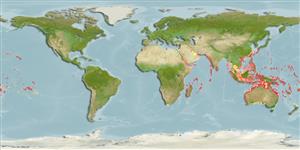
Indo-Pacific: Red Sea and East Africa (to False Bay, South Africa, Ref. 4404) to the Line, Marquesan, and Tuamoto Islands, north to southern Japan, south to New Zealand and Rapa. Replaced Plagiotremus goslinei in the Hawaiian Islands (Ref. 37816).
Tamaño / Peso / Edad
Madurez: Lm ? range ? - ? cm
Max length : 14.0 cm TL macho / no sexado; (Ref. 9710)
Descripción breve
Claves de identificación | Morfología | Morfometría
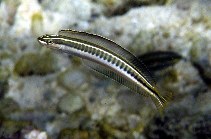
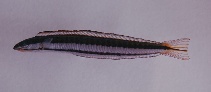
Espinas dorsales (total) : 7 - 9; Radios blandos dorsales (total) : 34 - 39; Espinas anales: 2; Radios blandos anales: 28 - 33. About 20 oblong segments form the dark midlateral body stripe (Ref. 4404).
Body shape (shape guide): elongated.
Adults inhabit clear lagoon and seaward reefs (Ref. 9710), usually the lower surge zone to deeper areas. They hide in deserted worm tubes when alarmed (Ref. 1602). They feed by attacking other fishes and removing dermal tissue, mucus and sometimes scales; occasionally makes harmless 'attacks' on divers (Ref. 2334, 48636). Some individuals usually strike from behind and quickly dive in the reef for cover to avoid punishment (Ref. 48636). Their wriggling swimming mode possibly mimics other non-scale eating species. Oviparous. Eggs are demersal and adhesive (Ref. 205), and are attached to the substrate via a filamentous, adhesive pad or pedestal (Ref. 94114). Larvae are planktonic, often found in shallow, coastal waters (Ref. 94114). Minimum depth reported taken from Ref. 128797.
Ciclo vital y comportamiento de apareamiento
Madurez | Reproducción | Puesta | Huevos | Fecundidad | Larva
Oviparous, distinct pairing (Ref. 205).
Randall, J.E., G.R. Allen and R.C. Steene, 1990. Fishes of the Great Barrier Reef and Coral Sea. University of Hawaii Press, Honolulu, Hawaii. 506 p. (Ref. 2334)
Situación en la Lista Roja de la UICN (Ref. 130435: Version 2025-2 (Global))
Amenaza para el ser humano
Usos humanos
Pesquerías: comercial; Acuario: Comercial
Herramientas
Informes especiales
Descargar XML
Fuentes de Internet
Estimaciones basadas en modelos
Temperatura preferida (Referencia
123201): 23.9 - 28.8, mean 27.5 °C (based on 638 cells).
Índice de diversidad filogenética (Referencia
82804): PD
50 = 0.5005 [Uniqueness, from 0.5 = low to 2.0 = high].
Bayesian length-weight: a=0.00479 (0.00257 - 0.00892), b=3.01 (2.84 - 3.18), in cm total length, based on LWR estimates for this species & (Sub)family-body (Ref.
93245).
Nivel trófico (Referencia
69278): 3.8 ±0.7 se; based on diet studies.
Resiliencia (Referencia
120179): Alto, población duplicada en un tiempo mínimo inferior a 15 meses (Preliminary K or Fecundity.).
Vulnerabilidad pesquera (Ref.
59153): Low vulnerability (10 of 100).
🛈
Nutrientes (Ref.
124155): Calcium = 103 [54, 164] mg/100g; Iron = 0.75 [0.46, 1.23] mg/100g; Protein = 18.4 [17.3, 19.4] %; Omega3 = 0.105 [0.061, 0.182] g/100g; Selenium = 26.2 [13.3, 54.7] μg/100g; VitaminA = 209 [79, 577] μg/100g; Zinc = 1.45 [0.98, 2.04] mg/100g (wet weight);