>
Blenniiformes (Blennies) >
Blenniidae (Combtooth blennies) > Blenniinae
Etymology: Plagiotremus: Greek, plagios = oblique + Greek, trema = hole (Ref. 45335).
More on author: Bleeker.
Περιβάλλον: περιβάλλον / κλιματική ζώνη / εύρος βάθους / εύρος διανομής
Οικολογία
Θαλασσινό(ά) Υφαλόφιλο(α); εύρος βάθους 0 - 45 m (Ref. 86942). Tropical; 30°N - 50°S
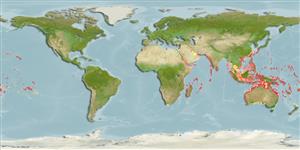
Indo-Pacific: Red Sea and East Africa (to False Bay, South Africa, Ref. 4404) to the Line, Marquesan, and Tuamoto Islands, north to southern Japan, south to New Zealand and Rapa. Replaced Plagiotremus goslinei in the Hawaiian Islands (Ref. 37816).
Μέγεθος / Βάρος / Ηλικία
Γεννητική Ωρίμανση: Lm ? range ? - ? cm
Max length : 14.0 cm TL αρσενικό/απροσδιόριστο; (Ref. 9710)
Σύντομη περιγραφή
Κλείδες προσδιορισμού | Μορφολογία | Μορφομετρία
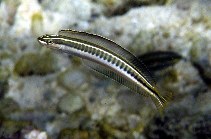
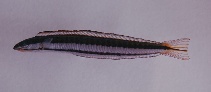
Ραχιαίες άκανθες (συνολικά) : 7 - 9; Μαλακές ραχιαίες ακτίνες (συνολικά) : 34 - 39; Εδρικές άκανθες: 2; Μαλακές εδρικές ακτίνες: 28 - 33. About 20 oblong segments form the dark midlateral body stripe (Ref. 4404).
Body shape (shape guide): elongated.
Adults inhabit clear lagoon and seaward reefs (Ref. 9710), usually the lower surge zone to deeper areas. They hide in deserted worm tubes when alarmed (Ref. 1602). They feed by attacking other fishes and removing dermal tissue, mucus and sometimes scales; occasionally makes harmless 'attacks' on divers (Ref. 2334, 48636). Some individuals usually strike from behind and quickly dive in the reef for cover to avoid punishment (Ref. 48636). Their wriggling swimming mode possibly mimics other non-scale eating species. Oviparous. Eggs are demersal and adhesive (Ref. 205), and are attached to the substrate via a filamentous, adhesive pad or pedestal (Ref. 94114). Larvae are planktonic, often found in shallow, coastal waters (Ref. 94114). Minimum depth reported taken from Ref. 128797.
Κύκλος ζωής και συμπεριφορά ζευγαρώματος
Γεννητική Ωρίμανση | Αναπαραγωγή | Γεννοβολία | Αβγά | Γονιμότητα | Προνύμφες
Oviparous, distinct pairing (Ref. 205).
Randall, J.E., G.R. Allen and R.C. Steene, 1990. Fishes of the Great Barrier Reef and Coral Sea. University of Hawaii Press, Honolulu, Hawaii. 506 p. (Ref. 2334)
Κατάσταση Κόκκινου Καταλόγου IUCN (Ref. 130435: Version 2025-2 (Global))
Ανθρώπινες χρήσεις
αλιεία: Εμπορικό(ά); Ενυδρείο: Εμπορικό(ά)
Εργαλεία
Ειδικές εκθέσεις
Λήψη XML
Διαδικτυακές πηγές
Εκτιμήσεις βάσει μοντέλων
Προτιμώμενη θερμοκρασία (Αναφ.
123201): 23.9 - 28.8, mean 27.5 °C (based on 638 cells).
Δείκτης φυλογενετικής ποικιλότητας (Αναφ.
82804): PD
50 = 0.5005 [Uniqueness, from 0.5 = low to 2.0 = high].
Bayesian length-weight: a=0.00479 (0.00257 - 0.00892), b=3.01 (2.84 - 3.18), in cm total length, based on LWR estimates for this species & (Sub)family-body (Ref.
93245).
Τροφικό Επίπεδο (Αναφ.
69278): 3.8 ±0.7 se; based on diet studies.
Ελαστικότητα (Αναφ.
120179): Υψηλό, ελάχιστος χρόνος για διπλασιασμό πληθυσμού < 15 μήνες (Preliminary K or Fecundity.).
Ευπάθεια στην αλιεία (Ref.
59153): Low vulnerability (10 of 100).
🛈
Θρεπτικά συστατικά (Ref.
124155): Calcium = 103 [54, 164] mg/100g; Iron = 0.75 [0.46, 1.23] mg/100g; Protein = 18.4 [17.3, 19.4] %; Omega3 = 0.105 [0.061, 0.182] g/100g; Selenium = 26.2 [13.3, 54.7] μg/100g; VitaminA = 209 [79, 577] μg/100g; Zinc = 1.45 [0.98, 2.04] mg/100g (wet weight);