>
Blenniiformes (Blennies) >
Blenniidae (Combtooth blennies) > Blenniinae
Etymology: Plagiotremus: Greek, plagios = oblique + Greek, trema = hole (Ref. 45335).
More on author: Bleeker.
Ambiente: milieu / zona climática / intervalo de profundidade / gama de distribuição
Ecologia
marinhas associadas(os) a recifes; intervalo de profundidade 0 - 45 m (Ref. 86942). Tropical; 30°N - 50°S
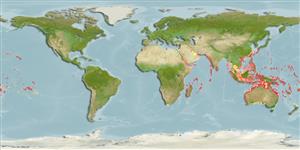
Indo-Pacific: Red Sea and East Africa (to False Bay, South Africa, Ref. 4404) to the Line, Marquesan, and Tuamoto Islands, north to southern Japan, south to New Zealand and Rapa. Replaced Plagiotremus goslinei in the Hawaiian Islands (Ref. 37816).
Tamanho / Peso / Idade
Maturidade: Lm ? range ? - ? cm
Max length : 14.0 cm TL macho/indeterminado; (Ref. 9710)
Descrição breve
Chaves de identificação | Morfologia | Morfometria
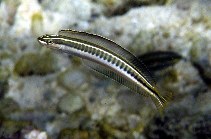
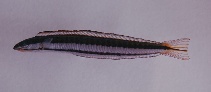
Espinhos dorsais (total) : 7 - 9; Raios dorsais moles (total) : 34 - 39; Espinhos anais: 2; Raios anais moles: 28 - 33. About 20 oblong segments form the dark midlateral body stripe (Ref. 4404).
Body shape (shape guide): elongated.
Adults inhabit clear lagoon and seaward reefs (Ref. 9710), usually the lower surge zone to deeper areas. They hide in deserted worm tubes when alarmed (Ref. 1602). They feed by attacking other fishes and removing dermal tissue, mucus and sometimes scales; occasionally makes harmless 'attacks' on divers (Ref. 2334, 48636). Some individuals usually strike from behind and quickly dive in the reef for cover to avoid punishment (Ref. 48636). Their wriggling swimming mode possibly mimics other non-scale eating species. Oviparous. Eggs are demersal and adhesive (Ref. 205), and are attached to the substrate via a filamentous, adhesive pad or pedestal (Ref. 94114). Larvae are planktonic, often found in shallow, coastal waters (Ref. 94114). Minimum depth reported taken from Ref. 128797.
Ciclo de vida e comportamento de acasalamento
Maturidade | Reprodução | Desova | Ovos | Fecundidade | Larvas
Oviparous, distinct pairing (Ref. 205).
Randall, J.E., G.R. Allen and R.C. Steene, 1990. Fishes of the Great Barrier Reef and Coral Sea. University of Hawaii Press, Honolulu, Hawaii. 506 p. (Ref. 2334)
Categoria na Lista Vermelha da IUCN (Ref. 130435: Version 2025-2 (Global))
Utilização humana
Pescarias: espécies comerciais; Aquário: Espécies comerciais
Ferramentas
Relatórios especiais
Descarregue XML
Fontes da internet
Estimativas baseadas em modelos
Temperatura preferida (Ref.
123201): 23.9 - 28.8, mean 27.5 °C (based on 638 cells).
Índice de diversidade filogenética (Ref.
82804): PD
50 = 0.5005 [Uniqueness, from 0.5 = low to 2.0 = high].
Bayesian length-weight: a=0.00479 (0.00257 - 0.00892), b=3.01 (2.84 - 3.18), in cm total length, based on LWR estimates for this species & (Sub)family-body (Ref.
93245).
Nível Trófico (Ref.
69278): 3.8 ±0.7 se; based on diet studies.
Resiliência (Ref.
120179): Elevada, tempo mínimo de duplicação da população menor que 15 meses (Preliminary K or Fecundity.).
Vulnerabilidade da pesca (Ref.
59153): Low vulnerability (10 of 100).
🛈
Nutrientes (Ref.
124155): Calcium = 103 [54, 164] mg/100g; Iron = 0.75 [0.46, 1.23] mg/100g; Protein = 18.4 [17.3, 19.4] %; Omega3 = 0.105 [0.061, 0.182] g/100g; Selenium = 26.2 [13.3, 54.7] μg/100g; VitaminA = 209 [79, 577] μg/100g; Zinc = 1.45 [0.98, 2.04] mg/100g (wet weight);