>
Blenniiformes (Blennies) >
Blenniidae (Combtooth blennies) > Salariinae
Etymology: Blenniella: Diminutive of blennius, Greek,blenios = mucus (Ref. 45335).
More on author: Bleeker.
Taxonomic Remarks
Genus Williams, pers. comm.
Ambiente: milieu / zona climática / intervalo de profundidade / gama de distribuição
Ecologia
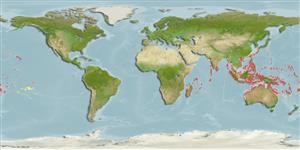
marinhas associadas(os) a recifes; intervalo de profundidade 0 - 6 m (Ref. 1602). Tropical; 32°N - 30°S, 37°E - 129°W
Indo-Pacific: east coast of Africa to the Society Islands, north to the Ryukyu Islands, south to about 24°S.
Tamanho / Peso / Idade
Maturidade: Lm ? range ? - ? cm
Max length : 13.0 cm SL macho/indeterminado; (Ref. 9710)
Descrição breve
Chaves de identificação | Morfologia | Morfometria
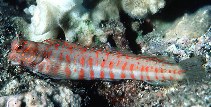
Espinhos dorsais (total) : 12; Raios dorsais moles (total) : 20 - 21; Espinhos anais: 2; Raios anais moles: 21 - 22. Distinctive coloration of the head (Ref. 48636).
Body shape (shape guide): elongated.
Adults inhabit clear coastal reef flats, often in exposed habitats, common in outer intertidal reef flats and surge-swept seaward reef; usually where algal growth is prolific (Ref. 48636). They enter small holes, with just its head protruding. They feed on algae and associated detritus and small invertebrates. Oviparous. Eggs are demersal and adhesive (Ref. 205), and are attached to the substrate via a filamentous, adhesive pad or pedestal (Ref. 94114). Larvae are planktonic, often found in shallow, coastal waters (Ref. 94114). Minimum depth of 0 m reported from Ref. 90102.
Ciclo de vida e comportamento de acasalamento
Maturidade | Reprodução | Desova | Ovos | Fecundidade | Larvas
Distinct pairing (Ref. 205).
Springer, V.G. and J.T. Williams, 1994. The Indo-West Pacific blenniid fish genus Istiblennius reappraised: a revision of Istiblennius, Blenniella, and Paralticus, new genus. Smithson. Contrib. Zool. 565:1-193. (Ref. 9962)
Categoria na Lista Vermelha da IUCN (Ref. 130435: Version 2025-2 (Global))
Ameaça para o homem
Harmless
Utilização humana
Pescarias: sem interesse; Aquário: Espécies comerciais
Ferramentas
Relatórios especiais
Descarregue XML
Fontes da internet
Estimativas baseadas em modelos
Temperatura preferida (Ref.
123201): 25.4 - 29.3, mean 28.5 °C (based on 2491 cells).
Índice de diversidade filogenética (Ref.
82804): PD
50 = 0.5020 [Uniqueness, from 0.5 = low to 2.0 = high].
Bayesian length-weight: a=0.00776 (0.00354 - 0.01702), b=3.00 (2.81 - 3.19), in cm total length, based on LWR estimates for this (Sub)family-body shape (Ref.
93245).
Nível Trófico (Ref.
69278): 2.5 ±0.19 se; based on food items.
Resiliência (Ref.
120179): Elevada, tempo mínimo de duplicação da população menor que 15 meses (Preliminary K or Fecundity.).
Vulnerabilidade da pesca (Ref.
59153): Low vulnerability (10 of 100).
🛈
Nutrientes (Ref.
124155): Calcium = 129 [63, 209] mg/100g; Iron = 0.731 [0.420, 1.245] mg/100g; Protein = 18.1 [16.9, 19.2] %; Omega3 = 0.0767 [, ] g/100g; Selenium = 19.1 [9.3, 41.6] μg/100g; VitaminA = 127 [35, 464] μg/100g; Zinc = 2.21 [1.47, 3.17] mg/100g (wet weight);